By Sandip Sahani – Founder, Sanrovax | Performance Marketing & Growth Systems
How to advertise on ChatGPT is one of the most searched questions in digital marketing right now – and for good reason. ChatGPT launched advertising on February 9, 2026, opening what is arguably the highest-intent advertising surface on the internet to brands for the first time. This guide covers everything Indian businesses need to know — what the platform is, how it works, what it costs, whether India is included, and exactly how to prepare.
Introduction
Here is a number that reframes how you should think about search advertising in 2026.
ChatGPT has 800 million weekly active users globally – making it one of the largest interactive platforms on the internet. And unlike social media users who are passively scrolling, or even search engine users who are browsing results, ChatGPT users are actively asking questions, seeking recommendations, and making decisions in real time. Someone typing “which CRM should I use for my small business?” into ChatGPT is not browsing. They are at the decision point.
That is the surface where you can now advertise on ChatGPT.
OpenAI officially began testing advertising inside ChatGPT on February 9, 2026, starting with users in the United States, Canada, Australia, and New Zealand. The rollout has moved faster than almost anyone expected. Within 60 days of launch, the pilot had crossed $100 million in annualised ad revenue with several hundred advertisers participating. OpenAI projects $2.5 billion in advertising revenue for 2026, scaling to $11 billion by 2027.
For Indian businesses, the picture has two layers. Learning how to advertise on ChatGPT matters now – not because India has full access today, but because the India rollout is expected by Q3–Q4 2026, the preparation window is open, and the businesses building their ChatGPT advertising readiness today will have a 6–12 month head start over competitors who wait for the India launch announcement before paying attention.
This guide tells you everything: how ChatGPT ads work, what they cost, who can currently access them, and exactly what Indian businesses should be doing right now.
What Are ChatGPT Ads and How Do They Work?
Before understanding how to advertise on ChatGPT, you need to understand what makes this platform fundamentally different from every other advertising channel – because the differences are significant and directly affect how campaigns should be structured.
The Fundamental Difference – Conversational Context vs. Keyword Matching
On Google, you buy keywords. Your ad appears when someone searches a term that matches your bid. The targeting is intent-based but backward-looking – the user typed something, you matched it.
On Meta, you buy audiences. Your ad appears to people who match demographic and behavioral profiles. The targeting is predictive but not directly responsive to what the user is doing right now.
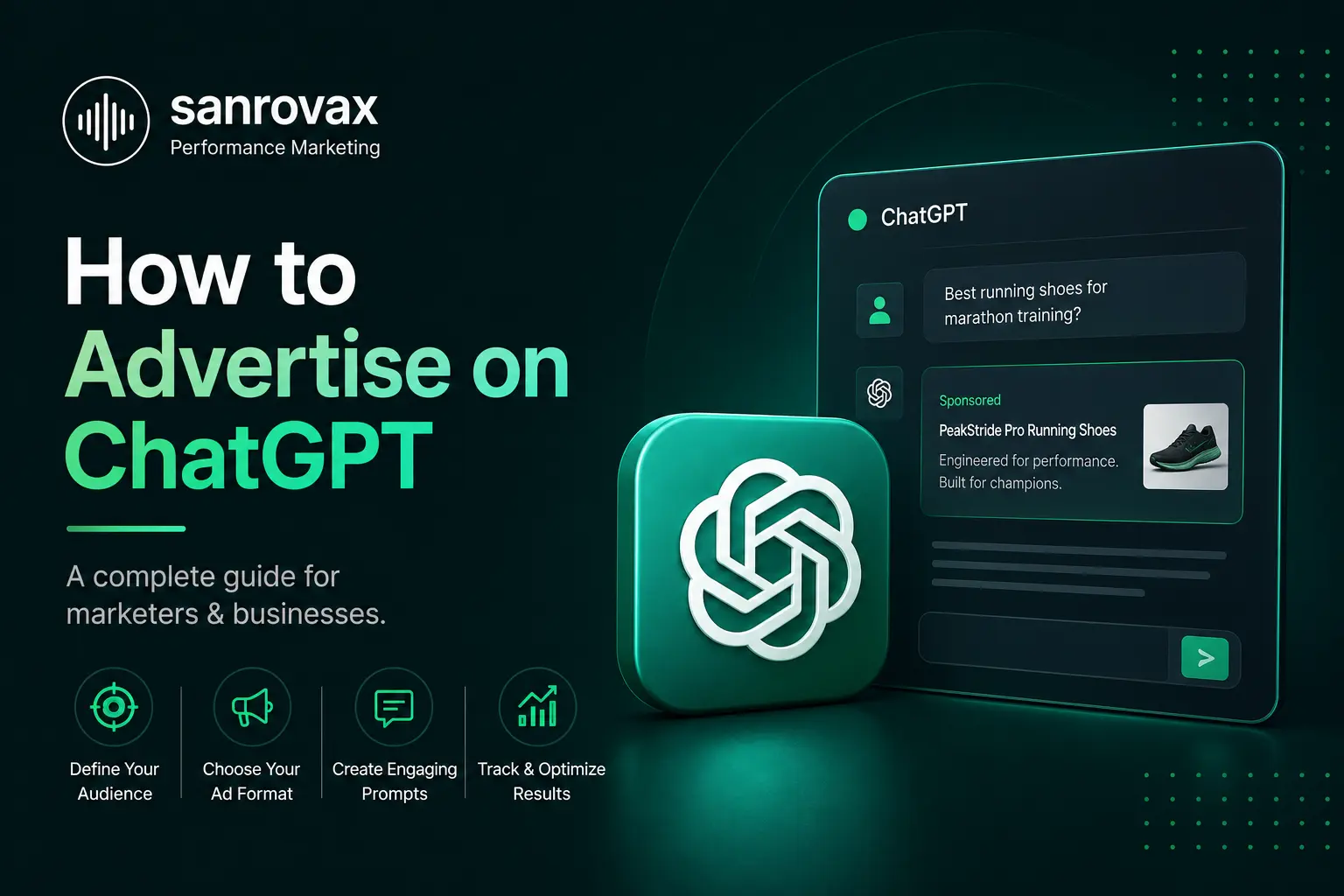
On ChatGPT, you buy conversation context. Your ad appears at the end of a ChatGPT response when the conversation topic is relevant to your product or service. The user asked a question. ChatGPT answered. Your sponsored content appears as a natural follow-on – clearly labelled “Sponsored” but contextually aligned with what the user was just thinking about.
This is what makes how to advertise on ChatGPT strategically different. ChatGPT users are in the deepest possible engagement mode – they have articulated a specific need in natural language, they have read a detailed AI response, and they are in an active decision-making frame of mind. The advertising surface captures them at the highest-intent moment in their research journey.
According to OpenAI’s own transparency reporting, the early results are encouraging: “We’re seeing no impact on consumer trust metrics, low dismissal rates of ads, and ongoing improvements in the relevance of ads as we learn from feedback.”
How ChatGPT Ads Actually Appear
Ads appear at the bottom of ChatGPT responses – after the AI has completed its answer. They are visually separated from the organic response and clearly labelled with a “Sponsored” tag. This placement means the ad does not interrupt the user’s interaction with the AI. They first receive the helpful answer they came for. Then, below that answer, they see the sponsored content.
This is the critical architectural difference from search ads (which appear before organic results) and social ads (which interrupt content). ChatGPT’s ad placement is designed to feel like a natural commercial extension of the conversation – not an interruption.
For product-related queries, ChatGPT also supports sponsored product cards similar to Google Shopping – visually rich placements that include product images, pricing, and direct purchase links.
Privacy Architecture
How to advertise on ChatGPT without accessing private conversation data is a question every advertiser rightly asks. OpenAI’s privacy architecture is explicit: advertisers cannot see individual user conversations. The company never sells user data to advertisers. Ads are contextually targeted based on the current conversation topic and anonymized intent signals – not behavioral profiles built from personal data. Users can turn off personalization and clear data used for ad targeting at any time.
This context-over-behaviour approach positions ChatGPT ads closer to contextual advertising than to the behavioral targeting that defines Meta and programmatic platforms.
ChatGPT Ad Formats – The 3 Types
Understanding the formats is essential when learning how to advertise on ChatGPT – because the creative requirements and strategic fit of each format are meaningfully different.
Format 1 – Sponsored Recommendations (Post-Response Cards)
The primary format for how to advertise on ChatGPT campaigns. After ChatGPT completes its response, sponsored cards appear below the answer. These cards typically include:
- Brand name and logo
- A short headline (recommended under 200 characters)
- A brief description relevant to the conversation context
- A CTA button or link to a landing page
Best for: Service businesses, SaaS products, high-consideration purchases where the user’s question indicates active research. A user asking “what is the best email marketing tool for a small business?” sees a sponsored recommendation for a relevant email platform immediately after ChatGPT’s answer.
The key principle for this format: the ad must feel like a natural helpful extension of the conversation, not a promotional interruption. Copy that sounds like “The #1 platform in the world!” underperforms significantly compared to copy like “Managing your email list for a small team? Try [Product] – 2,000 contacts free, no credit card required.”
Format 2 – Conversational Ads (Native Recommendations)
A more integrated format where product or service suggestions are embedded within the flow of the AI’s response itself, clearly labelled as sponsored but woven into the conversational answer. This format is still being tested and refined by OpenAI as part of the pilot program.
Best for: Product discovery scenarios where the user is asking for category recommendations rather than comparing specific brands. A user asking “what tools should I use to start freelancing?” might receive a conversational response that includes both organic recommendations and a sponsored mention of a relevant platform.
Format 3 – Sponsored Product Cards (Shopping Format)
For product-led queries, ChatGPT supports shopping-style placements that display product images, pricing, reviews, and direct purchase links – similar to Google Shopping ads but embedded in the conversational interface. This format uses commerce partnerships, with Criteo serving as the first official ad tech partner for shopping placements.
Best for: E-commerce brands, D2C products, retail – any business where the user is asking about products they can buy rather than services they need to evaluate.
How ChatGPT Ads Targeting Works
The targeting system for how to advertise on ChatGPT is unlike any other platform – and understanding it changes how you think about campaign structure.
Contextual Intent Matching – Not Keyword Bidding
ChatGPT does not sell keywords in the traditional sense. You cannot bid on “best CRM software” the way you would in Google Ads. Instead, the platform uses conversation topic matching – your ad appears when OpenAI’s system determines that the current chat conversation is contextually relevant to your product or service.
This means the preparation work for how to advertise on ChatGPT is not a keyword research exercise. It is an Intent Mapping exercise – understanding what questions your target customers are likely to ask ChatGPT before they would be ready to hear from your brand.
A practical approach: create 30–50 realistic prompts that your target customers might type into ChatGPT when they are in the discovery, consideration, or decision stage for your product category. These prompt clusters become the contextual territories where your ads should appear. Share them with your campaign team as the targeting brief.
Privacy-Safe Targeting Dimensions
Beyond conversation context, ChatGPT ads use:
- Current conversation topic – the primary matching signal
- User’s past chat history – aggregated and anonymized topic patterns, not individual transcripts
- Past ad interactions – how the user has previously engaged with sponsored content
- Subscription tier – ads only appear for Free and Go tier users ($8/month). Plus ($20/month), Pro ($200/month), Team, Business, Enterprise, and Education accounts are ad-free
OpenAI explicitly does not use: individual conversation transcripts, personal identifiers, purchase history, or third-party data sources.
Who Does NOT See ChatGPT Ads
This is important for targeting planning. Ads are blocked for:
- Users on Plus, Pro, Team, Business, Enterprise, and Education subscriptions
- Accounts where users identify as under 18
- Accounts where OpenAI’s system predicts underage users
- Users who have disabled ad personalization
The ChatGPT audience exposed to ads is the Free and Go tier – which, given the platform’s 800 million weekly active users, still represents one of the largest high-intent advertising audiences on the internet.
ChatGPT Ads Cost – Official Pricing Timeline
The how to advertise on ChatGPT cost story is one of the most dramatic pricing compression narratives in digital advertising history. Understanding the full timeline helps businesses plan realistic budget expectations for when India access opens.
February 9, 2026 – Launch at Premium Pricing
OpenAI launched how to advertise on ChatGPT campaigns with:
- CPM: $60 per 1,000 impressions (approximately ₹5,000 CPM at launch rates)
- Minimum spend: $200,000–$250,000 (approximately ₹1.7–2.1 crore)
- Access: Invitation-only. Launch partners included Target, Ford, Adobe, Mrs. Meyer’s, and Expedia
- Channel: Managed only – through agency holding companies Dentsu, Omnicom, Publicis, and WPP
At $60 CPM, ChatGPT ads were priced at approximately 3x Meta’s CPM and comparable to premium television inventory like NFL game advertising. OpenAI’s positioning was explicit: this is a premium placement for premium advertisers.
March-April 2026 – Rapid Compression
Within 10 weeks of launch, the pricing picture changed substantially:
- CPM dropped to $25–$45 in pilot categories (some advertisers accessed as low as $25 via Criteo’s programmatic channel)
- Minimum spend reduced to $50,000 (approximately ₹42 lakhs)
- CPC bidding introduced (April 21, 2026) – advertisers can now set bids of $3–$5 per click
- Criteo joined as first official ad tech partner – enabling programmatic buying at lower minimums
The speed of compression reflects a market reality: at $60 CPM and $200K+ minimums, the advertiser universe was tiny. OpenAI needed to open access to reach its revenue targets.
May 2026 – Self-Serve Opens
- Self-serve Ads Manager launched at ads.openai.com — available to a subset of US advertisers
- No minimum spend on self-serve platform
- Additional tech partners: StackAdapt, Kargo, Pacvue, and Adobe join alongside Criteo
- Advertisers can now set CPC bids, deploy conversion pixels, and manage campaigns independently
Current Pricing (June 2026)
| Model | Rate | Notes |
|---|---|---|
| CPM (Managed) | $25–$60 | Varies by category and inventory |
| CPM (Programmatic via Criteo) | $15–$45 | Lower floor via programmatic |
| CPC (Self-serve) | $3–$5 | Recommended starting bid |
| CPC (High-value categories) | $8–$25 | Finance, Legal, SaaS |
| CPC (Standard categories) | $3–$6 | E-commerce, Travel, Education |
| Minimum (Self-serve) | No minimum | |
| Minimum (Managed) | $50,000 | Down from $200,000 at launch |
Sources: Wask.co OpenAI Ad Pricing 2026, Artzen.io ChatGPT Ads Guide May 2026, TheNextWeb April 2026, ads-openai.com May 2026
India-Specific Cost Projection
When how to advertise on ChatGPT becomes fully available in India, the pricing pattern will likely follow the global trajectory: CPMs will be meaningfully lower than US rates (consistent with how Meta, Google, and YouTube all price India inventory at 10–20x lower than US CPM benchmarks). Indian CPC rates may start at ₹50–₹250 per click depending on category – making ChatGPT advertising accessible at much lower absolute budgets than the current US-market figures suggest.
How to Advertise on ChatGPT – Step by Step
Here is the current process for businesses that can access the platform. For Indian businesses, this is the preparation roadmap for when India access opens.
Step 1 – Register on OpenAI’s Advertiser Interest Page
Visit openai.com/advertisers and submit your business information. OpenAI uses this to prioritize access for the self-serve rollout. Even if your market does not yet have full access, registering signals intent and places you in the queue for early access. Sandip Sahani (Sanrovax) has already completed registration – we are in the access queue.
Step 2 – Access Ads Manager
For markets with current access, OpenAI’s Ads Manager is available at ads.openai.com. The interface allows campaign creation, audience configuration, creative upload, bid setting, and performance monitoring.
Step 3 – Define Your Intent Map
Before creating your first campaign, build your Intent Map – the 30–50 realistic prompts your target customers would type into ChatGPT during their decision journey. Organize these by funnel stage:
Awareness prompts: “What is [your product category] and how does it work?” Consideration prompts: “What are the best [your product category] tools for [use case]?” Decision prompts: “Compare [your brand] vs [competitor] for [specific need]”
This Intent Map becomes your campaign brief and helps you write ad copy that aligns with the specific conversational contexts where your ads will appear.
Step 4 – Create Your Ad Copy (Conversational, Not Promotional)
The most critical creative principle for how to advertise on ChatGPT: your copy must sound helpful, not promotional. ChatGPT users are in a conversation with an AI assistant. Ads that feel like traditional marketing copy create friction. Ads that feel like useful recommendations perform.
Avoid: “The #1 Platform in the World — Sign Up Now!” Use: “Managing leads for a small team? Try [Product] – free for 14 days, built for businesses under 50 users.”
Keep headline copy under 200 characters. Focus on the specific use case relevant to the conversation context.
Step 5 – Set Your Budget and Bidding Model
For self-serve access: Start with CPC bidding at $3–$5 per click for standard categories. High-value B2B categories (SaaS, Finance, Legal) may require $8–$15 bids to win competitive auctions.
For India launch planning: Convert US benchmark CPCs to Indian equivalents (typically 1/8 to 1/12 of US rates based on platform patterns), build a test budget of ₹50,000–₹2,00,000 for initial campaign validation.
Step 6 – Deploy Your Conversion Pixel
OpenAI’s Ads Manager supports conversion pixel deployment – allowing advertisers to track post-click actions (form fills, purchases, sign-ups) back to specific ChatGPT ad placements. Set up your pixel before campaign launch to capture attribution data from day one.
Step 7 – Monitor and Optimize
The self-serve Ads Manager provides real-time visibility into: Impressions, Clicks, CTR, Spend, and Conversions. Monitor CTR as your primary creative performance signal if CTR is below 0.5%, your copy is not resonating with the conversation context. Test different copy approaches before scaling budget.
ChatGPT Ads vs Google Ads vs Meta Ads
Understanding how how to advertise on ChatGPT fits into your existing channel mix requires an honest comparison against the platforms you are already using.
Intent Quality Comparison
| Platform | User State When Seeing Ad | Intent Level |
|---|---|---|
| ChatGPT | Actively asking a question, reading AI response | Highest |
| Google Search | Actively searching a keyword | High |
| YouTube | Watching relevant content | Medium |
| Meta Feed | Passively scrolling | Lower |
| Meta Reels | Entertainment consumption | Lower |
ChatGPT captures users at the deepest intent moment – not just searching, but engaged in a back-and-forth decision-making conversation with an AI.
Cost Comparison (Global Benchmarks, June 2026)
| Platform | CPM | CPC |
|---|---|---|
| ChatGPT (Global current) | $25–$60 | $3–$25 |
| Google Search | Variable | $1–$50 (category dependent) |
| YouTube India | ₹50–₹150 | ₹5–₹25 |
| Meta India | ₹11–₹45 | ₹2–₹55 |
| JioHotstar | ₹90–₹315 | ₹9–₹12 |
Where ChatGPT Fits in the Marketing Funnel
ChatGPT Ads = Lower funnel, decision-stage intent capture. Users are in active research mode, asking specific questions before making decisions. Best for high-consideration purchases, service businesses, SaaS, and B2B.
Google Ads = Lower funnel, keyword-triggered intent. Captures users who know what they want and are searching for options.
Meta Ads = Upper and mid funnel, audience discovery. Creates demand and retargets engaged prospects.
JioHotstar = Upper funnel, OTT brand awareness. Builds recognition during high-attention premium viewing.
The businesses that win in 2026 and beyond will use all four channels with clear role assignments – ChatGPT for decision-stage intent, Google for search intent, Meta for social discovery, JioHotstar for OTT awareness.
Is ChatGPT Advertising Available in India?
This is the most common question Indian businesses have about how to advertise on ChatGPT – and the honest answer requires separating what is confirmed from what is projected.
Current Status (June 2026)
ChatGPT ads launched February 9, 2026 for: United States, Canada, Australia, and New Zealand.
On May 7, 2026, OpenAI announced expansion of the ads pilot to: United Kingdom, Mexico, Brazil, Japan, and South Korea.
India is not yet in the confirmed pilot expansion list – but the indicators point strongly toward Q3–Q4 2026 inclusion.
Why India Is Next
India qualifies for every criterion OpenAI uses for market expansion:
Massive user base: India is one of ChatGPT’s top 5 markets globally by user count. ChatGPT Go ($8/month subscription) launched in India in August 2025, establishing the monetization infrastructure.
Advertiser demand: India’s digital advertising market is one of the fastest-growing globally at 28% annually. Indian businesses have been registering interest on OpenAI’s advertiser page since launch.
Revenue pressure: OpenAI is projecting $14 billion in losses in 2026. Expanding ad markets to high-growth regions like India is a direct revenue acceleration strategy.
Platform pattern: Every major global ad platform – Google, Meta, YouTube, LinkedIn – followed the same trajectory: US launch → major markets expansion → India inclusion within 6–18 months. ChatGPT is on the same curve.
What Indian Businesses Can Do Right Now
Even without full India access, there are four concrete actions Indian businesses should take before how to advertise on ChatGPT becomes fully available in India:
1. Register on openai.com/advertisers – Places your business in the access queue. Early registrants typically receive priority access invitations.
2. Build your Intent Map – The 30–50 prompts your customers would ask ChatGPT. This preparation takes time and is most valuable when done while the platform is being watched, not after launch day panic.
3. Develop conversational ad copy – Write ads that sound helpful, not promotional. This is a fundamentally different creative approach from Meta or Google copy. Practice and refine it now.
4. Audit your GEO visibility – Ask ChatGPT right now: “What are the best performance marketing agencies in India?” or “Which digital marketing agency should I use for Meta Ads in West Bengal?” If Sanrovax does not appear, your GEO (Generative Engine Optimization) work is incomplete. Businesses that appear in AI-generated answers organically will have a significant advantage when ChatGPT ads launch.
Which Businesses Should Advertise on ChatGPT?
The highest-ROI use cases for how to advertise on ChatGPT share one characteristic: the customer journey includes a research and comparison phase where they ask questions before deciding.
Strongest Fit
SaaS and Technology Products: Users actively ask ChatGPT to compare software tools, recommend platforms, and explain features. A startup building a project management tool, a CRM platform, or an accounting application has natural placement opportunities in these conversations.
Financial Services and Insurance: “Which health insurance is best for a family of four?” “What should I look for in a business loan?” These are exactly the high-intent ChatGPT queries where financial brands need to appear. The CPC rates for finance ($15–$25) are higher – but so is the customer lifetime value.
Healthcare and Wellness: Users ask ChatGPT for medical information, hospital recommendations, and wellness product research. Healthcare advertisers must comply with OpenAI’s policy restrictions on health claims – but the intent alignment is strong for hospitals, diagnostic chains, and pharmaceutical brands with compliant content.
EdTech and Professional Courses: “What skills should I learn to become a data analyst?” “Which online MBA programs are worth it?” ChatGPT is one of the primary research tools for education decisions – making it a natural channel for Indian EdTech brands.
B2B Services: Agencies, consultants, legal services, financial advisors – any B2B service where the buyer does significant research before shortlisting vendors. ChatGPT is rapidly replacing initial research phases that previously happened on Google.
D2C and E-Commerce (Product Categories): Users asking “what are the best skincare products for oily skin?” or “which protein supplement is good for beginners?” are in active purchase research mode. The Shopping Card format makes this a strong e-commerce channel.
Who Should Wait
Local businesses with small budgets: At current global pricing, ChatGPT advertising is not accessible for hyper-local campaigns with small budgets. JioHotstar CPC Fence at ₹9 per click and Meta Ads deliver better ROI at lower budgets for local reach.
Businesses with no content or research angle: If your product does not involve a research or comparison phase before purchase – commodity products, impulse buys, purely local services – ChatGPT’s intent alignment advantage does not apply.
Businesses in restricted categories: OpenAI prohibits or heavily restricts advertising for: alcohol, tobacco, gambling, adult content, weapons, and certain political categories. Businesses in these sectors cannot access the platform.
How to Prepare Your Brand Right Now
“The businesses that are going to win on ChatGPT advertising in India are not the ones who start preparing on the day India access opens,” says Sandip Sahani, Founder of Sanrovax and a performance marketing specialist working with Indian and Australian businesses. “They are the ones who started 6 months earlier – who have already built their Intent Maps, tested their conversational copy, audited their AI visibility, and registered for access. Launch day for everyone else is head-start day for them.”
Here is the concrete preparation checklist for Indian businesses learning how to advertise on ChatGPT:
Action 1: Register Now (5 Minutes)
Visit openai.com/advertisers. Submit your business details. Done. This costs nothing and positions you for early access invitations when India rollout expands.
Action 2: Build Your Intent Map (3–5 Hours)
Open ChatGPT. Search as your customer would. Document 30–50 realistic prompts across awareness, consideration, and decision stages. Note which prompts currently surface your competitors organically – those are the highest-priority targeting clusters for your future campaigns.
Action 3: Write Conversational Ad Copy (2–3 Hours)
For each major customer intent cluster, write 3–5 ad copy variations. Test the “helpful, not promotional” principle. The copy that reads like useful advice outperforms copy that reads like a billboard.
Action 4: Audit Your GEO Presence (1 Hour)
Open ChatGPT and ask:
- “What are the best [your category] businesses in [your city/region]?”
- “Which [your service] should I use for [your customer’s use case]?”
- “Compare the top [your industry] companies in India”
If your brand does not appear organically, this is your GEO gap. Fix it before paid ads launch – because organic AI visibility will directly influence ad relevance scoring.
Action 5: Prepare Your Landing Pages (Ongoing)
ChatGPT traffic behaves differently from Meta or Google traffic. Users who click from ChatGPT have already read a detailed answer. They come to your landing page informed – with specific questions already formed. Your landing page should answer those specific questions immediately, not start from scratch with generic brand positioning.
How Sanrovax Helps Businesses Prepare for ChatGPT Advertising
At Sanrovax, how to advertise on ChatGPT is a conversation we are already having with clients — not one we are waiting to have until India access opens.
We have personally registered on OpenAI’s advertiser platform. We have tested the interface, tracked the pricing evolution from $60 CPM to $3–$5 CPC, monitored the expansion announcements, and built the Intent Map frameworks that will underpin our clients’ ChatGPT campaigns when India rollout happens.
Our preparation work for clients covers four areas:
GEO Optimization: Making sure Sanrovax clients appear in ChatGPT’s organic answers for their category and geography — before paid placement becomes available. Brands that already have AI-generated visibility will benefit from relevance score advantages when ads launch.
Intent Map Development: Building the complete library of customer prompts relevant to each client’s category. This becomes the targeting blueprint for Day 1 of ChatGPT advertising in India.
Conversational Creative Development: Writing and testing ad copy in the format that ChatGPT’s advertising environment rewards. This is a different skill from Meta copy or Google headline writing — and building this capability now means being campaign-ready immediately.
Multi-Channel Integration: Positioning ChatGPT within the full performance system – alongside Meta Ads, Google Ads, YouTube, and JioHotstar – so that when ChatGPT advertising activates, it immediately fits into a coherent, attribution-tracked performance architecture.
The businesses that treat ChatGPT advertising as a future problem to solve later are the ones who will face a competitor who started earlier. The gap between early preparers and late starters on new advertising platforms consistently runs 12–24 months of catchup – at higher costs, with less favorable positioning.
FAQ – How to Advertise on ChatGPT
Q1: How to advertise on ChatGPT – is it available in India?
As of June 2026, how to advertise on ChatGPT for Indian advertisers is not yet in the confirmed rollout list. ChatGPT ads launched February 9, 2026 in the US, Canada, Australia, and New Zealand. UK, Mexico, Brazil, Japan, and South Korea were added in May 2026. India is expected by Q3–Q4 2026 based on OpenAI’s expansion pattern and India’s position as one of ChatGPT’s largest user markets.
Q2: How much does it cost to advertise on ChatGPT?
How to advertise on ChatGPT costs: CPM ranges from $25–$60 for managed campaigns; CPC bidding (available from April 2026) starts at $3–$5 for standard categories and $8–$25 for high-value categories (Finance, Legal, SaaS). Minimum spend has dropped from $200,000 at launch to $50,000 for managed access, with no minimum on the self-serve platform. Indian CPC rates are expected to be significantly lower when India rollout begins.
Q3: What ad formats are available to advertise on ChatGPT?
There are three primary formats for how to advertise on ChatGPT: (1) Sponsored Recommendations – post-response cards appearing after ChatGPT’s answer with brand name, headline, and CTA; (2) Conversational Ads — native recommendations integrated within the AI’s response, clearly labelled sponsored; (3) Sponsored Product Cards – shopping-style placements with product images, pricing, and purchase links for product-led queries.
Q4: Who can see ChatGPT ads?
ChatGPT ads are shown only to Free and Go tier users ($8/month). Users on Plus ($20/month), Pro ($200/month), Team, Business, Enterprise, and Education subscriptions see zero ads. Ads are also blocked for users under 18 and those who have disabled ad personalization. When learning how to advertise on ChatGPT, this audience definition is important for reach planning.
Q5: How does ChatGPT ad targeting work?
ChatGPT ad targeting for how to advertise on ChatGPT is conversational context-based – not keyword bidding. OpenAI matches ads to conversations using: current conversation topic (primary signal), user’s past chat history (aggregated and anonymized), and past ad interactions. Advertisers do not access individual user conversations. Behavioral data from third-party sources is not used.
Q6: How to advertise on ChatGPT – is it better than Google Ads?
ChatGPT and Google Ads serve different intent moments. How to advertise on ChatGPT captures users in active decision-making conversations – the deepest intent state in research. Google Search captures users who are actively typing specific queries. Both are high-intent channels, but ChatGPT’s conversational depth creates engagement that keyword-triggered search cannot replicate. For most businesses, ChatGPT will complement Google Search, not replace it.
Q7: What businesses are blocked from advertising on ChatGPT?
OpenAI’s advertising policies restrict or prohibit: alcohol brands, tobacco products, gambling platforms, adult content, weapons manufacturers, certain pharmaceutical categories, and political advertising. Businesses in these categories cannot advertise on ChatGPT regardless of geography. Healthcare and financial service advertisers can participate but with strict content restrictions around claims.
Q8: How to register to advertise on ChatGPT?
To register how to advertise on ChatGPT, visit openai.com/advertisers and submit your business details. For markets with current access, the self-serve Ads Manager is at ads.openai.com. For managed campaigns, access is through agency holding companies (Dentsu, Omnicom, Publicis, WPP) or approved ad tech partners (Criteo, StackAdapt, Kargo, Pacvue, Adobe). Indian businesses can register on openai.com/advertisers now to receive early access notifications when India rollout begins.
Q9: Can I advertise on ChatGPT with a small budget?
The original $200,000 minimum has compressed significantly. The current self-serve platform at ads.openai.com has no minimum spend – any advertiser can set up an account, configure CPC bids, and run campaigns. For Indian businesses planning to advertise on ChatGPT when India access opens, small-budget test campaigns will be feasible at Indian market CPC rates (expected to be significantly lower than US rates based on all other platform pricing patterns).
Q10: What is the difference between ChatGPT ads and GEO (Generative Engine Optimization)?
When you advertise on ChatGPT, you pay for sponsored placement after ChatGPT responses – this is paid media. GEO (Generative Engine Optimization) is the practice of making your brand appear organically in ChatGPT’s answers – this is earned media. Both matter. Brands with strong organic GEO visibility will benefit from relevance advantages in paid ChatGPT advertising. The preparation for both starts with the same Intent Map – understanding what your customers ask ChatGPT and ensuring your brand is the answer.
Conclusion – The Window to Prepare Is Open
How to advertise on ChatGPT will be the most important new advertising capability for Indian businesses in the second half of 2026.
The numbers are clear. ChatGPT has 800 million weekly active users globally. OpenAI projects $2.5 billion in ad revenue for 2026. India’s full commercial rollout is expected by Q3–Q4 2026. The pricing trajectory from $60 CPM to $3–$5 CPC shows a platform rapidly democratizing access – following the exact same pattern as Google AdWords and Facebook Ads in their respective early days.
The businesses that understand how to advertise on ChatGPT early will hold a structural advantage that lasts years. Not because they found a shortcut – but because they built the Intent Maps, the conversational creative capability, and the GEO visibility that makes ChatGPT advertising effective before the India auction gets competitive.
At Sanrovax, we are already preparing – registered, researching, and building the frameworks that will make our clients’ ChatGPT advertising ready from Day 1 of India access.
If you want a clear answer on whether ChatGPT advertising fits your business goals – and what your preparation should look like right now – let us have that conversation.
Book Your Free 30-Minute Strategy Call → sanrovax.com
No pressure. No pitch. Just a clear, honest conversation about your business.
Key Statistics – How to Advertise on ChatGPT 2026
Platform Scale:
- ChatGPT weekly active users: 800 million+
- ChatGPT ads launch date: February 9, 2026
- Launch markets: US, Canada, Australia, New Zealand
- May 2026 expansion: UK, Mexico, Brazil, Japan, South Korea
- India expected: Q3–Q4 2026
- OpenAI projected ad revenue 2026: $2.5 billion
- OpenAI projected ad revenue 2027: $11 billion
Pricing Evolution:
- Launch CPM (Feb 9, 2026): $60
- Current CPM range: $25–$60 (managed), $15–$45 (programmatic)
- CPC introduced: April 21, 2026
- Current CPC range: $3–$25 (category dependent)
- Launch minimum spend: $200,000–$250,000
- Current minimum (managed): $50,000
- Self-serve minimum: None
Ad Format Details:
- Formats: Sponsored Recommendations, Conversational Ads, Sponsored Product Cards
- Placement: Bottom of ChatGPT responses, after organic answer
- Label: “Sponsored” – clearly marked
- Audience: Free and Go tier users only (Plus, Pro, Business, Enterprise – ad-free)
Early Partners:
- Agency: Dentsu, Omnicom, Publicis, WPP
- Ad Tech: Criteo, StackAdapt, Kargo, Pacvue, Adobe
- Launch advertisers: Target, Ford, Adobe, Mrs. Meyer’s, Expedia
Sources: OpenAI Official Announcements February–May 2026, TechCrunch, Digiday, TheNextWeb, Wask.co, Artzen.io, ALMCorp, ads-openai.com, BrandStory.in, upGrowth.in
Data compiled by Sandip Sahani, Founder, Sanrovax – Performance Marketing & Growth Systems | sanrovax.com
Internal Links:
- How Google Ads Work
- How Meta Ads Work
- How to Run YouTube Ads
- How to Advertise on JioHotstar
- JioHotstar Fence Ads
- JioHotstar Ads Cost
Sandip Sahani — Founder, Sanrovax Performance Marketing & Growth Systems | Halisahar, West Bengal, India sandip@sanrovax.com
1 thought on “How to Advertise on ChatGPT – Complete Guide for Indian Businesses (2026)”