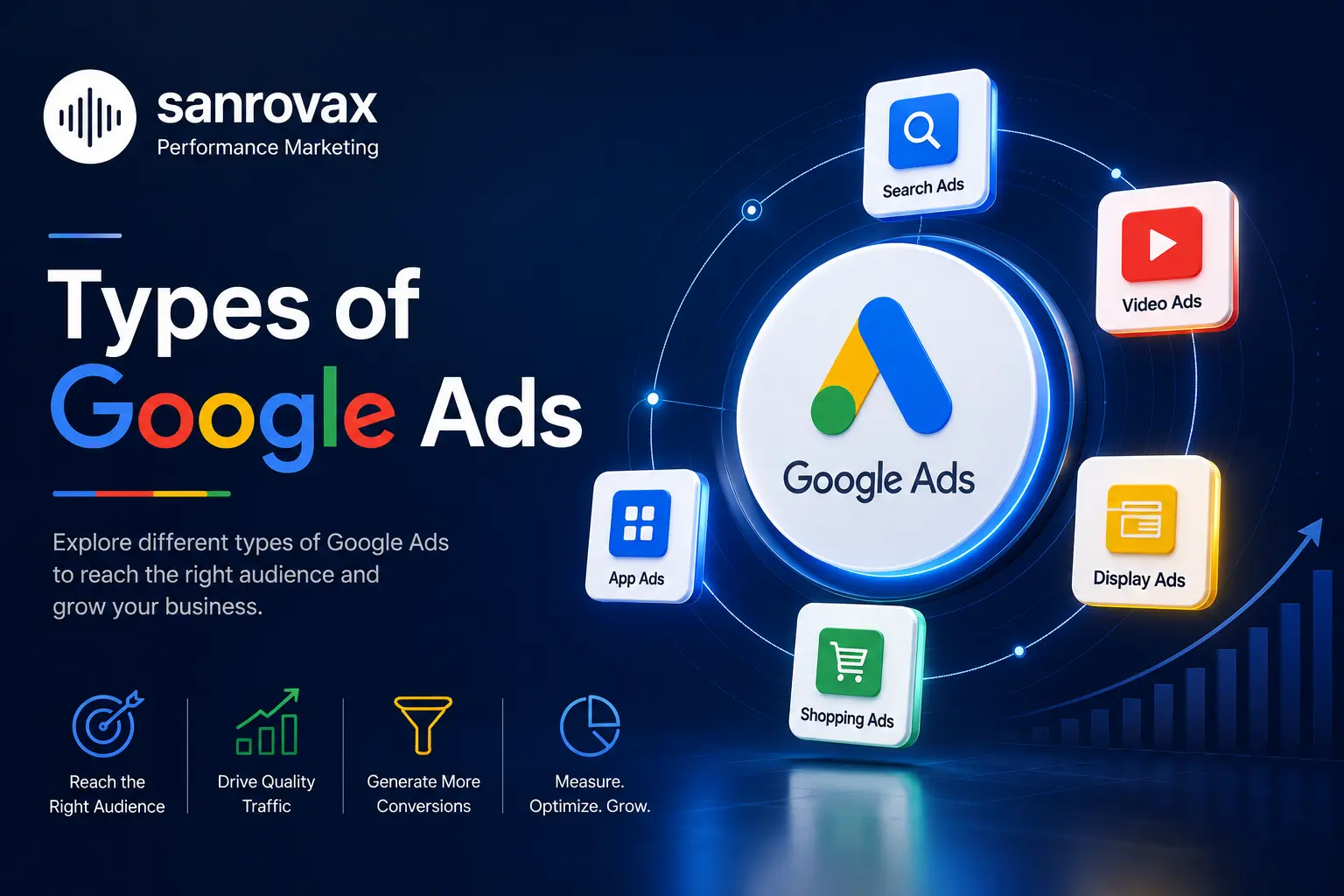
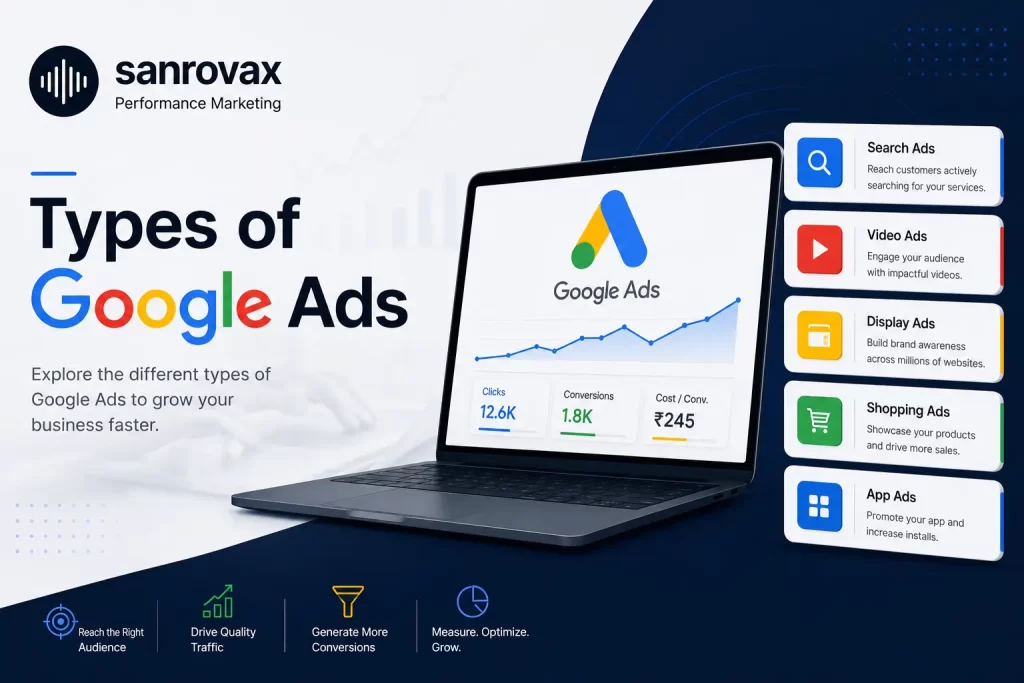
There are 9 types of Google ads in 2026. Most Indian businesses use one or two. And frequently, the wrong ones. This guide covers all 9 – what each type does, when to use it, when not to, and which format fits your specific business.
Introduction
Here is what makes the types of Google ads question more consequential than most advertisers realize.
Unlike Meta Ads – where the same business can run Image Ads, Video Ads, and Carousel Ads with similar underlying mechanics – the different types of Google ads are structurally distinct. They reach different users at different moments in their decision journey, use different bidding models, require different assets, and deliver results against completely different business goals.
Search campaigns capture 65% of Google’s ad revenue globally because they target users with the highest purchase intent – people who are actively typing a query to find a solution. Shopping campaigns drive 76% more clicks than text ads for e-commerce businesses because they match product imagery to product searches. Performance Max campaigns now account for 30% of all new Google Ads accounts because they automate optimization across every Google surface simultaneously.
India’s digital advertising market crossed $6.5 billion in 2025 and continues growing – and Google dominates the search advertising share of that market. With 8.5 billion searches processed globally every day, the opportunity for Indian businesses on Google is significant. But only for businesses running the right types of Google ads for their specific objective.
The most common mistake: a healthcare clinic running Display Ads to cold audiences when Search Ads would capture patients actively looking for exactly their service. A D2C brand running only Search Ads when Shopping Ads would deliver 76% more clicks at lower cost for the same product queries. An EdTech startup running Smart Campaigns and missing the precision control that their budget and targeting decisions require.
This guide covers all 9 types of Google ads – with India-specific pricing, real business examples, and the decision framework that tells you which format your business should actually be running.
Types of Google Ads – Quick Reference (All 9)
Before diving into each format in detail, here is the complete overview of all types of Google ads available in 2026.
| Type | What It Does | Billing Model | India CPC/CPV |
|---|---|---|---|
| Search Ads | Text ads in Google search results | CPC | ₹5–₹150 |
| Display Ads | Banner/image ads across 2M+ websites | CPM/CPC | ₹10–₹45 CPM |
| Shopping Ads | Product listings with image + price | CPC | ₹8–₹40 |
| Video Ads | YouTube + video partner sites | CPV/CPM | ₹0.82–₹2.47 CPV |
| App Campaigns | App installs + engagement across Google | CPI/CPA | Variable |
| Demand Gen | Social-style visual ads (YouTube, Gmail, Discover) | CPM/CPC | Variable |
| Performance Max | AI-automated across all Google channels | CPA/ROAS | Conversion-based |
| Smart Campaigns | Fully automated, simplified | CPC | Variable |
| Local Services Ads | Verified service business leads | CPL | Per lead |
Each of these types of Google ads serves a distinct purpose. None is universally superior. The right choice depends on your business model, campaign objective, budget, and where your target customer is in their decision journey.
1. Search Ads – The Most Important Types of Google Ads
What They Are
Search Ads are text-based advertisements that appear in Google’s search engine results pages (SERPs) when users type queries that match your targeted keywords. They are the most widely used and best-understood of all types of Google ads – and for good reason. Search captures users at their highest-intent moment: when they are actively looking for a solution.
When a user in Mumbai types “dermatologist clinic near me” or a business owner in Bengaluru searches “GST filing software for small business,” the text ads that appear at the top and bottom of those results are Search Ads. Your ad appears because it matched a keyword you bid on.
The Three Search Ad Formats
Responsive Search Ads (RSA) The primary Search Ad format in 2026. You provide up to 15 headlines (30 characters each) and 4 descriptions (90 characters each). Google’s AI automatically tests combinations, learns which headlines and descriptions perform best together for different queries, and progressively shows the highest-performing combinations more frequently.
RSA is the recommended starting point for Search campaigns because the automated testing generates performance data faster than manual A/B testing, and Google’s AI optimizes the combination matrix in real time.
Dynamic Search Ads (DSA) DSA automatically generates ad headlines by crawling your website content and matching it to user search queries. You specify your landing pages; Google determines which queries are relevant and writes the headline to match them.
Best for: Large e-commerce sites, service businesses with many offerings, or any website with substantial, well-structured content. The risk: less control over messaging. Google may pull content from your site that does not reflect your best marketing copy.
Call-Only Ads Mobile-specific ads where the only CTA is a direct phone call. The ad displays your business name, phone number, and a brief description – tapping it initiates a call without visiting any landing page.
Best for: Service businesses where the sale starts with a phone conversation – plumbers, electricians, doctors, lawyers, mechanics, dental clinics. In India’s service sector, Call-Only Ads consistently deliver high-intent leads at lower cost than standard Search Ads driving to contact forms.
When to Use Search Ads
Search Ads work when demand for your product or service already exists – meaning people are actively searching for what you offer. If a meaningful number of people in your target geography are typing queries relevant to your business, Search Ads are the most efficient way to capture that demand.
Best for: Healthcare, legal services, financial services, B2B software, coaching, local service businesses, real estate, automotive services – any category where the customer journey begins with a Google search.
Avoid when: You are creating a new product category where no search volume exists for your solution. If nobody is searching for what you sell, Search Ads find no audience to bid for. In this case, Display or Video Ads for awareness-building are the appropriate starting point.
India Pricing
India CPC for Search Ads ranges from ₹5–₹150 depending on category. Legal and financial services command the highest CPCs (₹80–₹150+). Healthcare and education run ₹15–₹60. Local service businesses in Tier 2 cities often find effective CPCs below ₹20 for non-competitive categories.
2. Display Ads – The Awareness Types of Google Ads
What They Are
Display Ads are visual advertisements – banners, images, and responsive creatives – that appear across the Google Display Network (GDN). The GDN comprises more than 2 million websites, apps, and videos that have partnered with Google to show ads. This network reaches approximately 90% of internet users globally.
When you are reading a news article on Times of India, checking a recipe site, or playing a mobile game – and you see a brand advertisement embedded in that content – that is likely a Display Ad from the GDN. Among all types of Google ads, Display has the widest reach but the lowest intent – users are not actively looking for your product when they see your ad.
Display Ad Formats
Responsive Display Ads (RDA) The primary display format. You provide headlines, descriptions, images, and logos. Google’s system automatically assembles these into ads sized and formatted for every available placement across the GDN. One set of assets covers every banner size and format across 2 million+ sites.
Static Image Banners Fixed-size banner images uploaded in standard dimensions. More design control than RDA but require creating multiple size variants.
Gmail Ads (Sponsored Promotions) Ads that appear in the Gmail Promotions and Social tabs. When clicked, they expand to an email-sized creative. Particularly effective for promotional offers, new product launches, and retargeting users who have visited your site.
HTML5 Animated Ads Animated creative formats for higher-impact awareness placements. Require HTML5 file creation – more production effort than static or RDA.
When to Use Display Ads
Display Ads serve two distinct purposes – and the strategy differs significantly between them.
For brand awareness (cold audiences): Display reaches users who have never heard of your brand. At ₹10–₹45 CPM, you can build awareness at scale across relevant websites and apps in your target category. The conversion rate from cold Display traffic is low – the goal is recognition, not immediate response.
For retargeting (warm audiences): Displaying ads to users who have already visited your website is where Display Ads deliver their strongest ROI. A user who visited your product page and left without purchasing sees your brand’s Display Ad while reading content elsewhere. This warm retargeting consistently delivers higher conversion rates than cold display at a fraction of the CPM cost of reaching new audiences.
Best for: Brand awareness campaigns, retargeting website visitors, cart abandoner campaigns, new product launches, FMCG brands building category presence.
Avoid for: Direct conversion campaigns targeting cold audiences. Running Display Ads to cold audiences and expecting sales-equivalent conversion rates is a consistent budget waste pattern.
India Pricing
Display CPM in India: ₹10–₹45 depending on audience quality, website category, and targeting parameters. Remarketing audiences command higher CPMs (₹25–₹60) because of their demonstrated intent.
3. Shopping Ads – E-Commerce Types of Google Ads
What They Are
Shopping Ads are product listing advertisements that appear at the top of Google search results with a product image, title, price, store name, and rating. Unlike Search Ads (which show text), Shopping Ads show the product itself – allowing shoppers to compare products, prices, and stores visually before clicking.
Shopping Ads require a Google Merchant Center account with an active product feed – a structured data file that tells Google about every product you sell. Among all types of Google ads, Shopping consistently delivers the highest click-through rates for e-commerce product searches.
Standard Shopping vs Performance Max Shopping
Standard Shopping Campaigns Manual control over bidding and product groups. You organize products into groups, set bids per group, and add negative keywords to prevent irrelevant search matches. More work to manage, but significantly more visibility into what is working and more control over budget allocation.
Best for: Advertisers with strong Google Ads experience who want granular control over which products receive budget and at what CPCs.
Performance Max (Shopping) Google’s AI manages product promotion across Search, Shopping, Display, YouTube, Gmail, and Discover simultaneously using your product feed as the core input. Requires less management but provides less transparency into where budget is being spent and which placements are converting.
Best for: Advertisers with conversion history (50+ conversions/month) who want to scale e-commerce revenue across Google’s full network.
What You Need to Run Shopping Ads
Before running this type of Google ads, you need:
- Google Merchant Center account – verified and linked to your Google Ads account
- Product feed – accurate data including product title, description, price, image, availability, and GTIN
- Website with valid product schema – helps Google match products to relevant queries accurately
- Compliant product pages – landing pages must match the information in your product feed
When to Use Shopping Ads
Shopping Ads are the highest-priority types of Google ads for any business selling physical products online. The 76% higher click-through rate versus text ads for the same product searches is not marginal – it fundamentally changes the economics of Google advertising for e-commerce brands.
Best for: D2C brands, online retailers, marketplace sellers building direct-to-consumer presence, any business with an active product catalogue.
Avoid: Service businesses (no products to show), businesses without Merchant Center setup or clean product feeds.
4. Video Ads – YouTube Types of Google Ads
What They Are
Video Ads appear on YouTube and across Google’s video partner network. They are the storytelling format among types of Google ads – the only format that can demonstrate a product, build genuine brand personality, and create emotional connection with an audience before they have made any purchase intent decision.
YouTube has 500 million active users in India – the largest video platform in the country. Video Ads reach those users across search, homepage, watch pages, and Shorts.
The Five Video Ad Formats
Skippable In-Stream Ads Play before, during, or after YouTube videos. Users can skip after 5 seconds. You pay only when users watch 30 seconds (or the full ad if shorter than 30 seconds) or click through to your website. The skip option means your budget is spent only on engaged viewers.
The most widely used Video Ad format. The challenge: the first 5 seconds must be compelling enough to make viewers choose to keep watching rather than skip.
Non-Skippable In-Stream Ads 15–20 second ads that play before or during YouTube videos with no skip option. Every user in your targeting sees the complete ad. Billing is CPM-based – you pay per 1,000 impressions regardless of engagement.
Best for: Short, punchy brand messages where guaranteed delivery matters more than engagement filtering. Particularly effective for product launches, seasonal campaigns, and high-brand-recall objectives.
Bumper Ads 6-second non-skippable ads. The shortest format among all types of Google ads. Best for retargeting users who have seen your longer video ads – reinforcing a message rather than introducing a brand. Bumper Ads are typically run as a companion to Skippable or Non-Skippable campaigns, not as standalone brand-building.
In-Feed Video Ads Appear in YouTube search results, the YouTube homepage feed, and the recommended videos panel. Users choose to click and watch – the highest-intent video format because the viewer actively selects the content. Best for product demonstrations, tutorials, and brand content that people would genuinely choose to watch.
YouTube Masthead Full-screen placement on the YouTube homepage for 24 hours. Available by reservation only (not self-serve). Premium pricing, guaranteed national or global reach in one day. Appropriate for major brand launches and national campaigns with significant budgets.
When to Use Video Ads
Best for: Brand storytelling where a static image is insufficient, product demonstrations that require motion and context, EdTech content where the product is teaching, D2C brands with strong visual products and lifestyle association, healthcare awareness campaigns, and coaches or service professionals building personal brand.
Avoid: Businesses without video production capability. A low-quality video ad is worse than no video ad – it creates a negative brand impression. If you cannot produce something that looks credible in the first 5 seconds on a phone screen, invest in Search or Display before Video.
India Pricing
CPV (Cost Per View) in India: ₹0.82–₹2.47 – among the most cost-efficient video advertising rates globally. CPM for Non-Skippable: ₹30–₹80. Minimum practical budget for meaningful Video Ad testing in India: ₹500/day, ₹50,000/month.
For detailed YouTube advertising setup, see our complete guide: How to Run YouTube Ads.
5. App Campaigns – Mobile Types of Google Ads
What They Are
App Campaigns (formerly Universal App Campaigns) promote mobile applications across Google’s entire network – Search results, Google Play Store listings, YouTube, and the Google Display Network – from a single campaign setup. They are the specialist format among types of Google ads for businesses whose primary product is a mobile application.
How App Campaigns Work
You provide creative assets: text headlines, descriptions, images, and videos. Google’s AI combines these assets and tests them across every eligible placement on Search, Play, YouTube, and GDN automatically. The system learns which asset combinations drive installs or in-app actions most efficiently and progressively allocates budget to the best-performing combinations.
App Install Campaigns optimize for new user downloads. The bid is set as a target CPI (Cost Per Install) – you tell Google how much you are willing to pay per install, and the system optimizes delivery to achieve that target.
App Engagement Campaigns target existing users of your app and optimize for specific in-app actions – purchases, level completions, subscription upgrades. Requires your app to be connected to Firebase and have conversion events configured.
When to Use App Campaigns
Among all types of Google ads, App Campaigns are the right choice when your business model depends on app adoption. The campaign structure is designed to maximize install volume and in-app conversion at a target CPA, making it far more efficient than attempting to drive app installs through Search or Display campaigns.
Best for: Gaming apps (India is one of the world’s largest mobile gaming markets), EdTech apps, fintech, food delivery, healthcare appointment booking, e-commerce apps building a mobile-first customer base, and any SaaS with a companion mobile app.
India advantage: India’s CPI rates for App Campaigns are significantly lower than global benchmarks – the combination of massive smartphone adoption and lower CPC rates makes India one of the most cost-efficient markets for mobile app acquisition through Google.
6. Demand Gen Campaigns – Discovery Types of Google Ads
What They Are
Demand Gen campaigns (evolved from Discovery Ads in 2024) are visual, social-style advertisements that appear across YouTube’s home feed and Shorts feed, Gmail’s Promotions and Social tabs, and Google Discover (the personalized content feed on Android and Chrome). They reach up to 3 billion monthly active users across these surfaces.
Among types of Google ads, Demand Gen is the format most similar to Meta Ads in intent and visual approach – designed to reach users who are not actively searching, but who are browsing content that signals potential interest in your category.
Demand Gen Ad Formats
Single Image Ads – Clean visual with headline and description. Appears in Gmail Promotions, Discover, and YouTube feed.
Carousel Ads – Multiple images in a swipeable format. Similar mechanics to Meta Carousel Ads. Best for showing product range, step-by-step demonstrations, or before/after content.
Video Ads – Short video creatives served in YouTube home feed and Shorts. Demand Gen video placements differ from standard YouTube In-Stream Video Ads – they appear in feed contexts rather than interrupting content.
Demand Gen vs Display Ads – The Key Difference
Both Demand Gen and Display Ads reach users who are not actively searching. The distinction:
Display Ads = Broad web placements across 2M+ sites + GDN network. Best for retargeting and low-CPM awareness.
Demand Gen = Premium visual placements on YouTube feed, Gmail, and Discover with social-style targeting. Better audience quality signal, more native feel, higher engagement rates.
Demand Gen is Meta-style advertising through Google’s ecosystem – particularly relevant for Indian D2C brands, lifestyle products, and consumer goods targeting the 18–35 demographic on YouTube and Discover.
7. Performance Max – The Automated Types of Google Ads
What They Are
Performance Max (PMax) is Google’s most powerful and most automated campaign type. A single PMax campaign simultaneously runs ads across every Google channel – Search, Display, YouTube, Gmail, Maps, Shopping, and Discover – with Google’s AI managing placement, bidding, audience targeting, and creative combination automatically.
PMax now accounts for 30% of all new Google Ads accounts in 2026. It represents Google’s direction for the platform – progressively more AI control, less manual configuration.
How Performance Max Works
You provide: creative assets (text, images, videos, logos), audience signals (your best-guess at who your customers are – Google uses these as starting signals, not hard targeting constraints), and your campaign goal (conversions, conversion value, new customers).
Google’s AI takes those inputs and determines – automatically and continuously — which of your assets to show, to whom, on which channel, at what time, at what bid. The system optimizes toward your stated goal across the full Google network simultaneously.
When Performance Max Delivers – and When It Doesn’t
PMax works best when:
- Your account has 50+ conversions per month – the AI needs conversion data to optimize effectively
- Your Google Pixel is set up correctly with Conversion API
- You have a full creative asset library (multiple headline variants, images, videos)
- Your goal is scaling volume at a target ROAS rather than learning
PMax struggles when:
- New accounts with minimal conversion history – the AI optimizes on too little data and wastes budget
- Accounts where control over specific placements or audiences is important
- Businesses in sensitive categories where automated placement decisions create brand safety risks
Honest assessment: Performance Max is powerful for accounts with established conversion data. For new accounts or smaller budgets, starting with targeted Search or Shopping campaigns – generating the conversion history that PMax needs – and graduating to PMax is a more reliable path to results.
8. Smart Campaigns – Simplified Types of Google Ads
What They Are
Smart Campaigns are Google’s fully automated, simplified advertising option – designed for small business owners who want to run Google ads without learning the full Ads Manager interface. Google manages targeting, bidding, ad creation, and placement automatically. You set a goal (calls, website visits, or store visits), write a brief business description, and set a daily budget. Google handles everything else.
The Honest Assessment of Smart Campaigns
Among all types of Google ads, Smart Campaigns are the most accessible but the least powerful. The trade-off is intentional: Google optimizes toward what its algorithm defines as your goal, with limited visibility into what it is actually doing or why.
Best for: Local service businesses running Google Ads for the first time with very small daily budgets (₹500–₹2,000/day). Smart Campaigns are a legitimate starting point for gaining initial familiarity with the platform.
Limitations:
- Very limited reporting – you cannot see which keywords triggered your ads
- Google’s optimization decisions are not visible or adjustable
- Performance plateau is common – Smart Campaigns rarely deliver the results of well-managed Search campaigns at equivalent budgets
Practical advice: Smart Campaigns work for basic local visibility. Graduate to Search campaigns with manual or enhanced CPC bidding as your budget and comfort with the platform grow.
9. Local Services Ads – Service Business Types of Google Ads
What They Are
Local Services Ads (LSAs) appear at the very top of Google search results – above standard Search Ads and above organic listings – with a “Google Guaranteed” or “Google Screened” badge next to the business listing. They display business name, rating, review count, and a click-to-call button.
The key difference from all other types of Google ads: Local Services Ads are billed per qualified lead, not per click. You only pay when a user contacts your business directly through the ad – making it a pure pay-per-lead model.
Google Guaranteed vs Google Screened
Google Guaranteed – For service businesses that perform work at a customer’s location: plumbers, electricians, HVAC technicians, house cleaners, locksmiths. Google verifies the business and offers a money-back guarantee to customers for unsatisfactory service.
Google Screened – For professional service businesses: lawyers, financial planners, real estate agents. The verification is lighter but still provides the credibility signal of a Google-reviewed badge.
India Availability
Local Services Ads have limited availability in India as of 2026 – they are currently rolling out progressively by city and business category. Indian businesses should check eligibility through their Google Ads account – the category and city list is expanding.
Best for when available: Any service business where customers search locally – electricians, plumbers, pest control, legal services, financial advisors, home renovation. The pay-per-lead model makes budget accountability straightforward – you pay only for actual business contact.
2026 New: AI Mode Ads – The Emerging Types of Google Ads
Google Marketing Live 2026 announced significant changes to how advertising works inside Google’s AI-powered search experience – and Indian businesses should be paying attention.
Google’s AI Mode has crossed 1 billion monthly active users globally. Queries in AI Mode average three times the length of traditional search queries – users are having conversations with Google rather than typing short keyword phrases. Three new Gemini-powered ad formats were announced at GML 2026:
Conversational Discovery Ads – Ads that appear within AI Mode conversation responses, contextually matched to the user’s detailed query rather than a simple keyword.
Universal Cart Promotions (UCP) – Shopping integration across all Google surfaces, allowing product discovery within AI-generated answers.
Ask Advisor Integration – AI-powered product and service recommendations that include sponsored content from advertisers with relevant offerings.
These new types of Google ads formats are in early rollout as of mid-2026. Indian businesses should begin preparing by: ensuring structured data and product schema are correctly implemented on their websites, building content that answers the detailed conversational queries that AI Mode users are asking, and registering interest in the early access programs for these formats.
The businesses that adapt their Google advertising strategy for AI Mode early will have the same advantage that early Search Ads adopters had in 2005 and early Facebook Ads adopters had in 2012.
Which Types of Google Ads Are Best for Indian Businesses?
The right types of Google ads for any Indian business depend on two variables: what the campaign needs to accomplish, and where the target customer is in their decision journey.
“The most consistent mistake I see when auditing Google Ads accounts for Indian businesses is single-format dependence,” says Sandip Sahani, Founder of Sanrovax and a performance marketing specialist working with Indian and Australian businesses. “A healthcare clinic running only Display Ads because a well-designed banner feels like good marketing – while missing the patients typing ‘ENT specialist near me’ on Search. A D2C brand running only Search Ads with text results while competitors are capturing 76% more clicks on the same product queries through Shopping Ads. The format mismatch is invisible until you compare the cost per acquisition across formats.”
Industry-Wise Recommendation Table
| Industry | Primary Type | Secondary Type | Why |
|---|---|---|---|
| Healthcare / Clinics | Search (+ Call-only) | Display retargeting | Patients search before booking |
| Real Estate / Builders | Search | Display awareness | Property decisions start with search |
| EdTech / Coaching | Search | Video (YouTube) | Tutorial content + direct search |
| D2C / E-Commerce | Shopping | Performance Max | Product listings beat text for products |
| Local Service Business | Search / LSA | Smart Campaigns | Service-based local intent |
| SaaS / B2B Tech | Search | Demand Gen | Decision-makers search + discovery |
| FMCG / Consumer Goods | Display | Video | Awareness, not search-based |
| Restaurant / Food | Search (local) | Smart Campaigns | Local search + maps |
| App Business | App Campaigns | Search | Install-optimized format |
| Finance / Insurance | Search | Display retargeting | Compliance + high-intent search |
Budget Tier Guide – Which Types of Google Ads to Run at Each Level
₹10,000–₹30,000/month: Start with Search only. Single format, maximum control, clearest attribution. Prove that your ad copy and landing pages convert before expanding to additional formats.
₹30,000–₹75,000/month: Add Display retargeting to your Search base. Your Search campaigns build an audience of website visitors – Display campaigns retarget that warm audience at low CPM. Two formats working together at a manageable budget level.
₹75,000–₹2,00,000/month: Add Shopping (for product businesses) or Video (for brand and content businesses) to the Search + Display base. Three-format coverage across intent capture, retargeting, and either product discovery or brand storytelling.
₹2,00,000+/month: Full multi-format strategy. Search + Shopping + Display + Video + Performance Max for accounts with established conversion history. Each format does a specific job in the funnel; PMax scales what the individual campaigns have already proven.
Expert Insight – Sandip Sahani, Founder, Sanrovax
“When I assess a Google Ads account, the first thing I look at is not the performance numbers – it is the campaign structure. Which types of Google ads are running, and are they matched to the funnel stage they are supposed to serve?
A business running Search and nothing else is leaving retargeting revenue on the table – every user who visited their site and left without converting is a warm lead that Display retargeting could recover at low CPM. A business running Performance Max before they have 50+ monthly conversions is feeding an AI system that has no data to learn from – and the results reflect that.
The correct approach is sequential: establish Search first, because it generates the conversion data everything else optimizes toward. Add Display retargeting once you have consistent Search traffic. Add Shopping if you have products. Add Video when you have video creative and a brand story worth telling. Introduce Performance Max when you have 60+ conversions per month and want to scale what is already working.
Indian businesses also have a specific advantage worth noting: India’s CPCs across all types of Google ads are significantly lower than global benchmarks. A Search campaign CPC of ₹15–₹20 in a services category that would cost $8–$12 in the US represents real budget efficiency. The question is whether that cost advantage is being used to reach the right audience with the right format – or being diluted by format mismatches that reduce conversion rates regardless of CPC.”
– Sandip Sahani, Founder, Sanrovax | Performance Marketing & Growth Systems
Sanrovax is a performance marketing and growth systems agency based in Halisahar, West Bengal, India, working with Indian and Australian businesses on Google Ads, Meta Ads, YouTube, JioHotstar, and full-funnel revenue systems.
How Sanrovax Helps Businesses Choose the Right Types of Google Ads
At Sanrovax, the question of which types of Google ads to run is answered before any campaign is created – not after the budget has been spent and the results have underperformed.
Every new Google Ads engagement begins with an account audit (for existing accounts) or a strategy session (for new accounts). Both cover the same ground: what is the business trying to accomplish, what does the customer’s decision journey look like, what conversion data already exists, and which types of Google ads are structurally matched to those answers.
We manage Search campaigns with keyword-level bid strategies and match type discipline – manual CPC or enhanced CPC for accounts where transparency into bid decisions matters, smart bidding strategies for accounts with sufficient conversion history. We build Shopping campaigns for D2C clients with properly structured Merchant Center feeds and product group segmentation. We run Video campaigns for clients with video creative – scripted and produced to specific format requirements for Skippable, Non-Skippable, and In-Feed placements. We introduce Performance Max for accounts that have generated the conversion baseline the AI needs to optimize effectively.
For Indian businesses, the format recommendation is also a budget conversation. At ₹30,000/month, the answer is almost always Search first. At ₹2,00,000+/month, the question is how to allocate across types of Google ads to cover the full customer journey without format redundancy.
Whether you are running Google Ads for the first time or looking to restructure an account that has plateaued, the starting point is always the same: understanding which types of Google ads your business actually needs, not which ones are easiest to set up.
FAQ – Types of Google Ads
Q1: Google ads mein kitne types hote hain?
As of 2026, there are 9 main types of Google ads: Search Ads, Display Ads, Shopping Ads, Video Ads, App Campaigns, Demand Gen Campaigns, Performance Max, Smart Campaigns, and Local Services Ads. Google also announced new AI Mode ad formats at Google Marketing Live 2026 that are in early rollout – Conversational Discovery Ads, Universal Cart Promotions, and Ask Advisor Integration.
Q2: Indian businesses ke liye best type of Google ads kaunsa hai?
For most Indian service businesses (healthcare, legal, coaching, local services): Search Ads are the highest-priority type of Google ads – they capture users actively searching for the service. For e-commerce and D2C brands with products: Shopping Ads deliver 76% more clicks than text ads for the same product searches. For app businesses: App Campaigns are purpose-built for install and engagement optimization. The right choice depends on your specific business model and campaign objective.
Q3: Search ads aur Display ads mein kya fark hai?
Search Ads are text-based and appear when users actively type queries – high intent, bottom-of-funnel. Display Ads are visual/banner ads that appear across 2M+ websites when users are passively browsing – lower intent, top-of-funnel awareness or retargeting. In the types of Google ads spectrum, Search captures existing demand; Display creates awareness or retargets warm audiences.
Q4: Performance Max kya hota hai aur kab use karein?
Performance Max is Google’s AI-automated campaign type that runs across all Google channels simultaneously – Search, Display, YouTube, Gmail, Maps, Shopping, Discover. It accounts for 30% of new Google Ads accounts in 2026. Use Performance Max when your account has 50+ conversions per month and you want to scale volume across all surfaces. Avoid it with new accounts lacking conversion history – the AI needs data to optimize and will underperform without it.
Q5: Shopping ads ke liye kya setup zaroori hai?
To run Shopping Ads (one of the types of Google ads requiring the most setup): you need a Google Merchant Center account verified and linked to your Google Ads account, an active product feed with accurate product titles, descriptions, prices, availability, and images, and a website with compliant product pages that match your feed data. Product schema markup on your website also helps Google match your products to relevant searches more accurately.
Q6: Video ads ka minimum budget India mein kitna hai?
For meaningful Video Ad testing among types of Google ads in India: ₹500/day is the technical minimum, but ₹50,000/month is the practical minimum to generate enough data to make optimization decisions. India’s CPV (Cost Per View) is ₹0.82–₹2.47 – among the lowest globally. Skippable In-Stream and In-Feed Video Ads are the most accessible entry formats at this budget level.
Q7: Types of Google ads mein sabse easy kaunsa hai start karne ke liye?
Smart Campaigns are the simplest type of Google ads to start – Google manages everything automatically. However, for businesses wanting actual control and visibility into performance, Search Ads with broad match modified or phrase match keywords and manual CPC bidding is the recommended starting point. Smart Campaigns are a beginner’s entry; Search Campaigns are a sustainable foundation.
Q8: Demand Gen aur Display ads mein kya fark hai?
Both Demand Gen and Display Ads reach users who are not actively searching. The difference: Display Ads run across the broad GDN (2M+ sites and apps), best for retargeting and low-CPM awareness. Demand Gen runs on premium placements – YouTube home feed, Shorts feed, Gmail, Google Discover – with a social-style visual format and audience targeting similar to Meta Ads. Demand Gen typically has higher CPMs but higher-quality audience signals among these types of Google ads.
Q9: Local Services Ads India mein available hain kya?
Local Services Ads (the pay-per-lead format with Google Guaranteed/Screened badge) have limited availability in India as of 2026 and are expanding progressively by city and business category. Indian businesses should check eligibility in their Google Ads account. Where available, LSAs are highly effective for local service businesses because billing is per qualified lead rather than per click.
Q10: Performance Max vs Search – kaunsa better hai 2026 mein?
Neither type of Google ads is universally better – they serve different purposes. Search Ads give you keyword-level control and complete transparency into what is triggering your ads and what is converting. Performance Max gives AI full control across all channels and is optimized for conversion volume at a target CPA. The correct approach: establish Search first to generate conversion data, then introduce Performance Max to scale what Search has proven. Running PMax without Search-established conversion history consistently underperforms.
Conclusion – 9 Types of Google Ads. One Decision Framework.
The types of Google ads available in 2026 cover every stage of the customer journey – from the moment of highest purchase intent (Search) to passive awareness while browsing content (Display), from product discovery (Shopping) to brand storytelling (Video), from app acquisition (App Campaigns) to automated cross-channel scaling (Performance Max).
The businesses consistently winning with Google advertising are not the ones running every type of Google ads simultaneously. They are the ones who matched the right format to the right objective at the right budget level – and built from a proven foundation before adding complexity.
The decision framework is straightforward:
Someone is actively searching for your product or service? → Search Ads.
You want to reach people who visited your site but didn’t convert? → Display retargeting.
You sell physical products online? → Shopping Ads.
You need to build brand awareness through video? → Video Ads.
You want to promote a mobile app? → App Campaigns.
You want social-style visual advertising through Google? → Demand Gen.
You have 50+ conversions/month and want to scale everything automatically? → Performance Max.
You’re a local business just starting out? → Smart Campaigns, then graduate to Search.
You’re a verified local service provider? → Local Services Ads.
At Sanrovax, we help Indian businesses choose the right types of Google ads for their specific situation – not the most popular format, not the most automated option, and not the one that requires the least thinking. The one that matches your customer’s journey and your campaign objective.
Book Your Free 30-Minute Strategy Call → sanrovax.com
No pressure. No pitch. Just a clear, honest conversation about your business.
Key Statistics – Types of Google Ads 2026
- Google processes 8.5 billion searches per day globally
- Search campaigns capture 65% of Google’s ad revenue
- Shopping Ads drive 76% more clicks than text ads for e-commerce
- Performance Max = 30% of all new Google Ads accounts in 2026
- Google AI Mode: 1 billion+ monthly active users globally
- India digital advertising market: $6.5 billion (2025)
- India CPV for Video Ads: ₹0.82–₹2.47
- India Display CPM: ₹10–₹45
- India Search CPC range: ₹5–₹150 (category dependent)
- Total Google Ads campaign types in 2026: 9 (plus AI Mode formats in early rollout)
Sources: get-ryze.ai Google Ads Campaign Types April 2026, Hindustan Herald Google Marketing Live 2026, DigiQuick Meta vs Google Ads India 2026, Redback Types of Google Ads 2026, WsCubetech Google Ads Types 2026
Data compiled by Sandip Sahani, Founder, Sanrovax – Performance Marketing & Growth Systems | sanrovax.com
Internal Links:
- How Google Ads Work for Business
- How to Run YouTube Ads
- Google Ads Account Suspended
- Google Ads vs Facebook Ads
- Types of Meta Ads
- How Meta Ads Work
Sandip Sahani – Founder, Sanrovax Performance Marketing & Growth Systems | Halisahar, West Bengal, India sandip@sanrovax.com
3 thoughts on “Types of Google Ads – Stop Choosing the Wrong Format for Your Business (2026)”