By Sandip Sahani — Founder, Sanrovax | Performance Marketing & Growth Systems
The Google Ads vs Facebook Ads debate is one of the most searched questions in digital marketing. Every business owner with a limited budget faces it at some point. And in 2026, the answer is more nuanced — and more important — than it has ever been.
Introduction — The Google Ads vs Facebook Ads Question Every Business Owner Asks
Here is something that should change how you think about this debate forever.
In April 2026, for the first time in digital advertising history, Meta overtook Google in total worldwide ad revenue. Meta is forecast to reach $243.46 billion in net worldwide ad revenues in 2026, with Google reaching $239.54 billion. In terms of global ad spend share, Meta now controls 26.8% versus Google’s 26.4%.
That is not a small shift. That is a structural transformation in how the world’s biggest businesses are allocating their advertising budgets.
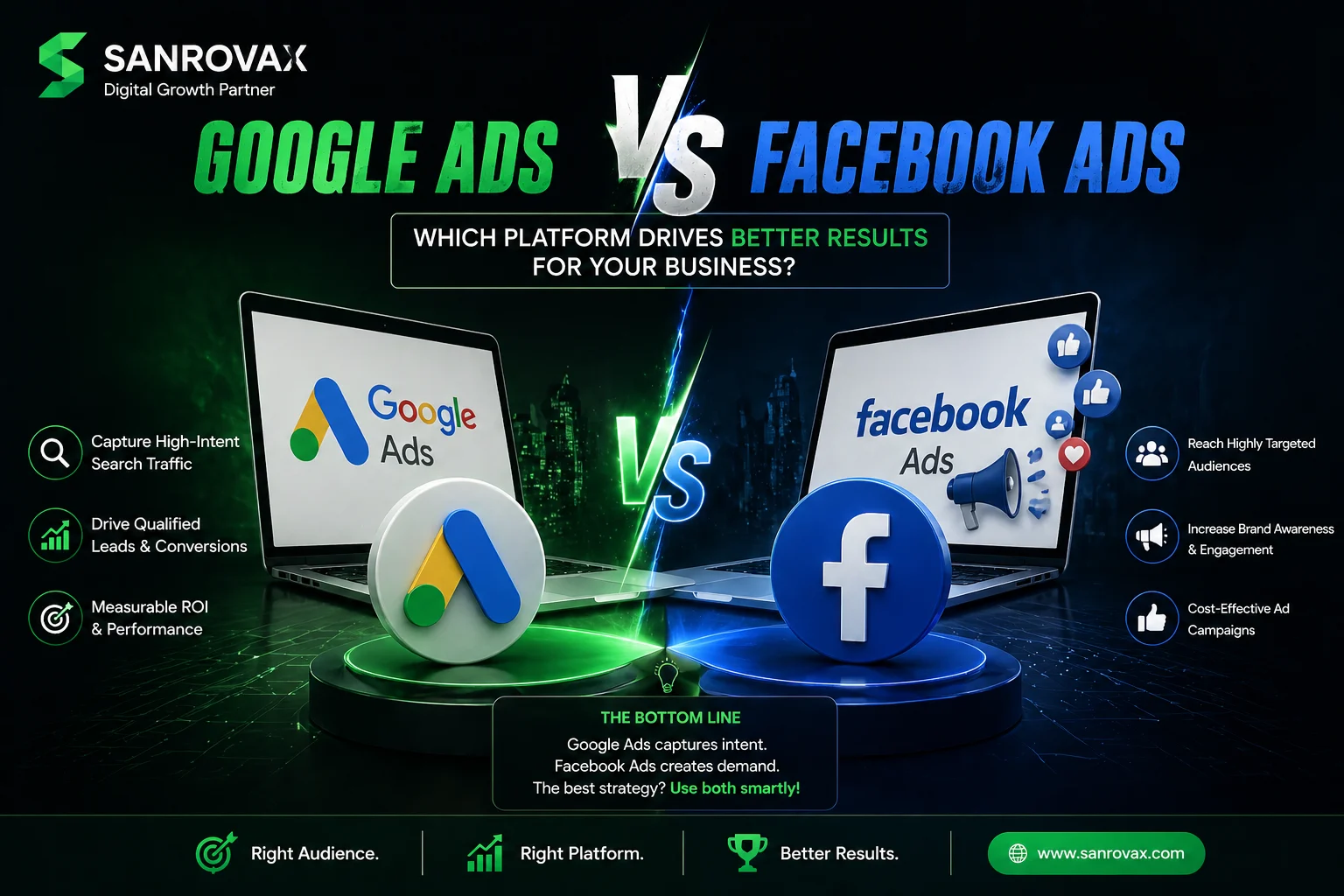
But here is what that headline does not tell you: Google and Meta are not competitors for your marketing budget. They solve completely different problems. Meta’s growth is coming from improved automation, AI-generated creatives, and better performance on discovery-driven campaigns — not from replacing Google’s search intent engine.
The google ads vs facebook ads debate misses the point entirely. The real question is: which platform solves your specific business problem right now, and how do you use both to create a system that compounds?
Here is the full picture in numbers:
- Google average CPC: $2.69 (Search), with some industries averaging $9+ per click
- Facebook/Meta average CPC: $0.62 — more than 4x cheaper per click
- Google Search average conversion rate: 3.75% across industries
- Meta Ads average conversion rate: 7.72% (down from 8.67% last year)
- Meta’s CPL has risen 21% year-over-year in 2026
- Businesses using both platforms increase ROI by up to 45% through full-funnel optimization
These numbers tell a story — but not the story most people expect. This guide will break it down clearly, so you can make the right decision for your business, with real data, not opinions.
How Google Ads Delivers ROI vs How Meta Ads Delivers ROI
This is the core of the google ads vs facebook ads comparison — not which platform is “better,” but how each one generates returns, and for which types of businesses.
How Google Ads Delivers ROI
1. Intent-Based Traffic — The Highest-Quality Click on the Internet
Google Ads captures existing demand. When someone types “emergency plumber near me” or “buy running shoes online” into Google, they are not browsing — they are ready to act. This is what makes Google Search the most powerful bottom-of-funnel advertising platform ever built.
Google controls 39% of all digital ad spending globally and processes over 16.4 billion searches daily. Every one of those searches is a declared intent signal. You are not guessing what the user wants — they are telling you directly.
2. Higher Conversion Rates on High-Intent Queries
Google Search Ads deliver a 3.75% average conversion rate across industries — but for high-intent, high-ticket categories, that number climbs dramatically. Legal keywords convert at 6.98%. Finance at 5.10%. Healthcare at 3.36%. These are categories where someone searching already has a problem and needs a solution today.
Google’s higher CPC ($2.69 average) is offset by higher conversion intent. A $2.69 click that converts at 4% is more efficient than a $0.62 click that converts at 1%.
3. ROI Compounding Through Smart Bidding and Quality Score
Accounts using Smart Bidding, first-party data, and responsive search ads achieve higher ROI than those still relying on manual CPC bidding. Google’s AI-powered Performance Max campaigns, which run across Search, Display, YouTube, Gmail, and Maps simultaneously, are consistently delivering better results as the system accumulates conversion data.
Businesses using Smart Bidding see ROI of 9.4:1 versus 5.7:1 for manual campaigns. Every conversion you generate improves the algorithm’s targeting — meaning Google Ads gets more efficient the longer you run it.
4. Superior for High-Ticket, Urgency-Driven, and B2B Categories
Google gives you the fastest ROI on high-ticket, urgent-need services like legal, real estate, finance, and healthcare. If your customer has a problem they need solved today — a broken boiler, a legal issue, a healthcare appointment — they search Google first. They do not open Instagram.
5. Relatively Privacy-Proof Tracking
iOS 14.5 and subsequent privacy regulations impacted Facebook Ads more severely due to cross-app tracking reliance. Google Search campaigns remain relatively unaffected, relying on first-party intent data from search queries. This makes Google’s conversion tracking more reliable and more accurate than Meta’s in a privacy-first world.
How Meta Ads Delivers ROI
1. Demand Creation — Reaching People Who Do Not Know They Need You Yet
Meta Ads creates or expands demand. People on Instagram or Facebook are typically not searching for products. Still, Meta is useful for planning budgets and setting reasonable targets.
This is Meta’s superpower. A business selling a new fitness supplement cannot wait for people to search “best creatine for muscle recovery.” They need to create that desire first — and Meta’s visual, scroll-stopping feed environment is the best place on earth to do that.
2. The Cheapest Reach on the Internet
Facebook’s average CPC is $0.62, based on 2024-2025 data from WordStream, Revealbot, and Statista — one of the lowest among major ad platforms. Meta CPM averages $11.62 globally, compared to much higher rates on Google Display or LinkedIn.
For brand awareness, audience building, and top-of-funnel reach — Meta offers unmatched efficiency. With $500, you can reach 40,000+ targeted people on Meta. The same $500 on Google Search reaches far fewer people, but with much higher purchase intent.
3. Superior Visual Storytelling and Creative Targeting
Meta Ads work well for businesses that rely on stories and pictures, like retail, travel, entertainment, and D2C brands, which have high CTR and engagement.
Instagram Reels, Facebook carousels, Stories — Meta is built for businesses where the product or service tells its own story visually. A fashion brand, a restaurant, a skincare line — these products sell through aesthetics and emotion, not search intent.
4. Retargeting ROI — The Most Underused Lever in Digital Advertising
Where Meta truly shines is retargeting. Someone visits your website from a Google Ad, does not convert, and then sees your Instagram ad three times over the next week. By the time they are ready to buy, your brand is the one they remember.
The strongest initial strategy is to start by capturing high-intent traffic with Google Ads — people already searching for your solution — then retarget them on Facebook to stay top of mind and drive conversions. This two-step approach shortens the sales cycle and boosts ROI early.
5. Advantage+ AI Is Delivering Compounding Returns
Meta’s growth is not coming from just one source. Instead, it is unlocking more value across its entire ecosystem at the same time. Tools like Advantage+, AI-generated ad creatives, and its broader automation stack are improving performance across both Facebook and Instagram, with Reels being a big beneficiary. As a result, advertisers are getting better bang for their buck.
Meta’s 24.1% growth rate in 2026 versus Google’s 11.9% is largely driven by Advantage+ automation delivering measurably better results for advertisers who feed the system strong creative and clear conversion signals.
Quick Comparison Table: Google Ads vs Facebook Ads (2026)
| Factor | Google Ads | Meta/Facebook Ads |
|---|---|---|
| Average CPC | $2.69 | $0.62 |
| Average CPM | $38.40 | $11.62 |
| Avg. Conversion Rate | 3.75% | 7.72% |
| Best Funnel Stage | Bottom (Intent) | Top/Mid (Discovery) |
| Best For | High-ticket, B2B, urgent services | D2C, lifestyle, brand awareness |
| Minimum Budget | ~$20/day | ~$5/day |
| Learning Curve | Steep (2-3 months) | Moderate (1-2 months) |
| Privacy Impact | Low | High (iOS 14.5+) |
| ROI Timeline | Fast (days-weeks) | Slower (weeks-months) |
| Creative Requirement | Copy-driven | Visual-driven |
When to Run Google Ads vs When to Run Facebook Ads
This is the most practical part of the google ads vs facebook ads question — when does each platform actually make sense for your business?
Run Google Ads When:
Your customer knows they have a problem and is actively searching for a solution.
If your customer types their pain point into a search bar — you need to be there. Google Ads is the right choice for:
- Service businesses — plumbers, lawyers, dentists, electricians, accountants, consultants
- B2B companies — software, agencies, manufacturing, professional services
- Healthcare — clinics, diagnostic centers, specialist doctors
- Real estate — builders, brokers, co-working spaces
- High-ticket products with defined buyer intent — machinery, enterprise software, industrial equipment
- Local businesses — any business targeting people searching “near me”
Also run Google Ads when your industry is urgency-driven — the person needs a solution now, not in two weeks after seeing 10 Instagram posts. A plumbing emergency, a tax deadline, a medical appointment — these decisions happen through search.
Run Meta/Facebook Ads When:
Your customer does not know they need your product yet — or needs to be reminded they want it.
Meta/Facebook Ads is the right choice for:
- D2C brands — fashion, beauty, skincare, fitness, nutrition, lifestyle
- E-commerce — any product that sells better through visual demonstration
- Hospitality and food — restaurants, cafes, resorts, event venues
- Entertainment and events — shows, concerts, experiences, gaming
- EdTech and online courses — especially skill-building and lifestyle education
- App marketing — mobile-first products targeting 18-35 year olds
- Brand building for new businesses — when awareness is the first priority
Also use Meta/Facebook Ads for retargeting campaigns regardless of your industry. Anyone who has visited your website, watched your video, or interacted with your page is a warm prospect — and Meta delivers them the most cost-effective reminder in digital advertising.
The Honest Answer for Most Businesses
Businesses using both platforms can increase ROI by up to 45% through full-funnel optimization.
The google ads vs facebook ads question assumes you need to choose. Most businesses that ask this question have a budget that can run both — they just have not structured them correctly.
The highest-performing approach in 2026:
Step 1: Run Google Ads to capture people actively searching for your solution — bottom of funnel, highest intent, fastest conversion.
Step 2: Run Meta Ads to retarget your Google visitors, build brand awareness with cold audiences, and nurture leads who need more touchpoints before converting.
Step 3: Use GA4 for cross-channel attribution to understand which platform is influencing which conversions — and allocate budget based on real pipeline data, not platform-reported numbers.
This is not theory. This is how businesses generating consistent digital revenue actually operate in 2026.
How Sanrovax Helps Businesses Win with Google Ads and Meta Ads
At Sanrovax, we stopped asking “google ads vs facebook ads” a long time ago. The question we ask instead is: at what stage of the buying journey is your customer right now, and which platform reaches them most efficiently there?
That strategic shift is what separates profitable campaigns from expensive experiments.
Every engagement at Sanrovax starts with a full-funnel revenue audit — understanding your business model, your customer journey, your average order value, your margins, and your conversion touchpoints. This audit tells us exactly which platform should receive which percentage of your budget, and at what campaign stage.
From there, we build a unified Google + Meta system: Google Ads for high-intent search capture (Search campaigns, Performance Max, Shopping Ads for e-commerce) and Meta Ads for audience building, retargeting, and social proof campaigns that nurture the 97% of visitors who did not convert on the first visit.
We handle the complete technical infrastructure: Google Tag and Conversions API for accurate tracking, Meta Pixel and CAPI for privacy-resilient attribution, GA4 integration for cross-channel visibility, and landing pages optimized for each traffic source. Every campaign is built around one metric — cost per revenue, not cost per click.
Our weekly optimization process catches budget waste before it compounds. We test creative, refine audiences, refresh ad copy, and scale what works — systematically, every week. Whether you are investing ₹15,000/month or ₹5,00,000/month, we build systems that deliver measurable returns at your budget level.
FAQ — Google Ads vs Facebook Ads
Q1: Which has better ROI — Google Ads or Facebook Ads in 2026?
Neither platform universally delivers better ROI. There is no universal winner between Google Ads and Meta Ads in 2026. Google captures existing demand through search intent, while Meta creates new demand through discovery and creative. Google wins the bottom of the funnel and Meta wins the top. ROI depends entirely on your industry, product type, customer journey, and campaign structure.
Q2: Which platform is cheaper — Google Ads or Facebook Ads?
Facebook/Meta Ads are significantly cheaper per click ($0.62 average CPC vs Google’s $2.69). However, cheaper clicks do not always mean better ROI. Google’s higher-intent clicks convert at higher rates, meaning the true cost per acquisition can be lower on Google for urgency-driven and B2B categories.
Q3: Can I run Google Ads and Facebook Ads at the same time?
Absolutely — and you should. Businesses using both platforms can increase ROI by up to 45% through full-funnel optimization. Small businesses often start with Facebook Ads for lower costs and then scale with Google Ads for conversions. The platforms are complementary, not competitive.
Q4: Which platform is better for small businesses with a limited budget?
Start with Facebook/Meta Ads if your product is visual, D2C, or lifestyle-oriented — lower minimum budgets ($5/day) and faster audience testing. Start with Google Ads if you are a service business where customers actively search for what you offer — higher budget but faster conversion.
Q5: Why is Meta growing faster than Google in 2026?
Meta’s growth rate will accelerate from 22.1% in 2025 to 24.1% in 2026, versus Google’s steady 11.9%. Meta is unlocking more value across its entire ecosystem through tools like Advantage+, AI-generated ad creatives, and its broader automation stack. This does not mean Meta is better — it means Meta’s automation improvements are delivering better value for advertisers who use the platform correctly.
Q6: How do I measure which platform is actually driving conversions?
Set up GA4 with proper cross-channel attribution. Both platforms overclaim conversions in their own dashboards — a user who sees a Meta ad and then converts on Google will be credited to both platforms individually. GA4’s data-driven attribution model gives you the most honest view of which touchpoints are actually driving revenue.
Q7: What is the minimum budget for Google Ads vs Facebook Ads?
Facebook/Meta Ads: $5/day technically, but $20–$30/day minimum for meaningful data. Google Ads: $20/day minimum, but $30–$50/day recommended for Search campaigns in most Indian industries. For both platforms, commit to at least 30 days before evaluating performance.
Conclusion — Stop Choosing. Start Combining.
The google ads vs facebook ads debate is the wrong question for any business serious about growth in 2026.
Google captures the customer who is ready to buy. Meta captures the customer who will be ready to buy. You need both — at different stages, with different messages, tracked through a unified measurement system.
The businesses that grew their revenue most efficiently in 2025 were not the ones who picked a side. They were the ones who understood that Google is an intent engine and Meta is a discovery engine — and built systems that used both precisely for what they do best.
Here is the simple framework: use Google Ads to catch buyers in the moment they are searching. Use Meta Ads to build the brand trust that makes them click your Google ad when they finally do search.
Google gives you the conversion. Meta gives you the recognition that makes the conversion possible.
At Sanrovax, every client engagement starts with one simple question: what does a real result actually look like for your business — and which combination of platforms gets us there fastest?
If you are ready to stop debating platforms and start building a system that actually drives revenue, let us talk.
Book Your Free 30-Minute Strategy Call → sanrovax.com
No pressure. No pitch. Just a clear, honest conversation about your business.
Sandip Sahani — Founder, Sanrovax Performance Marketing & Growth Systems | Halisahar, West Bengal, India sandip@sanrovax.com