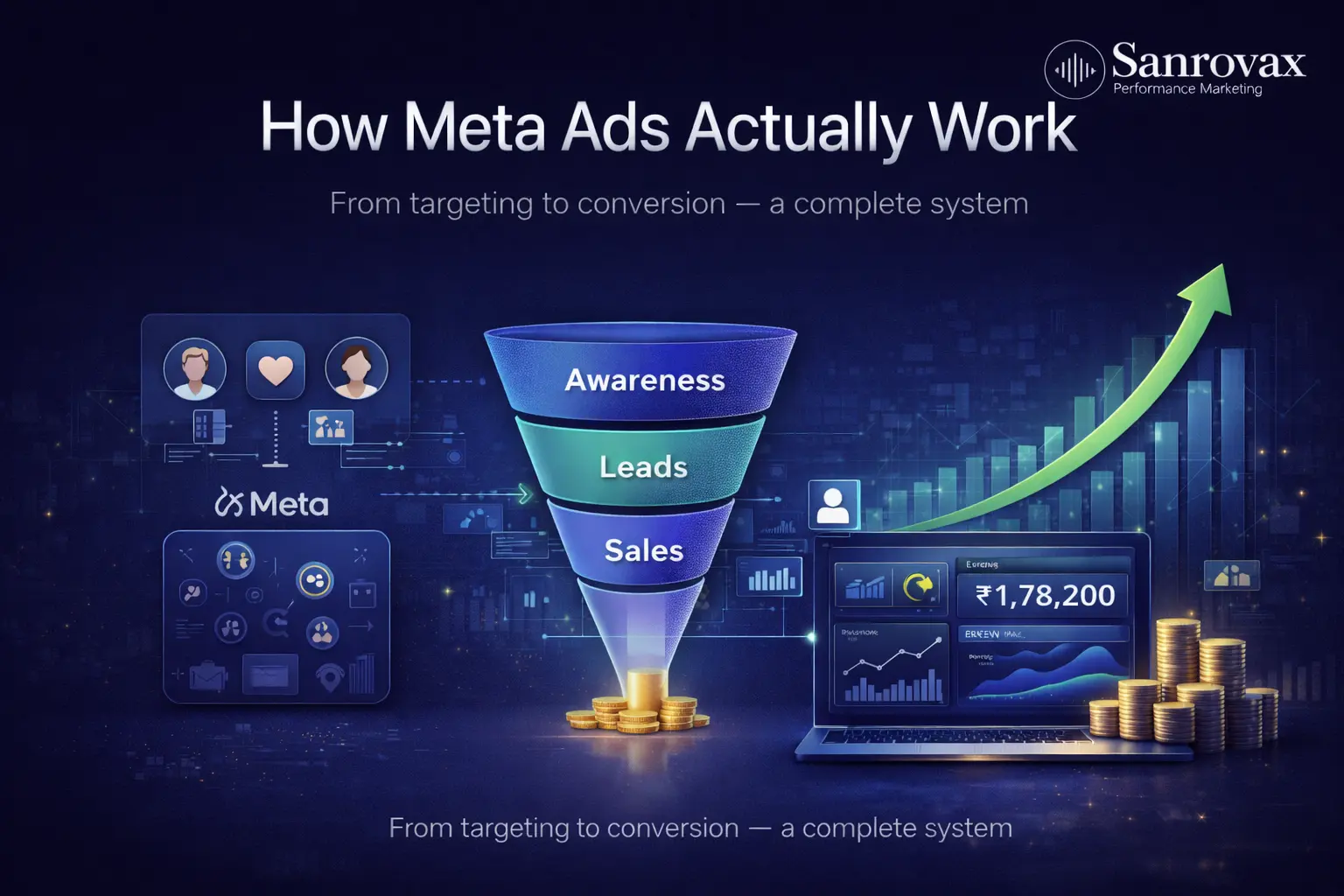
By Sandip Sahani — Founder, Sanrovax | Performance Marketing & Growth Systems
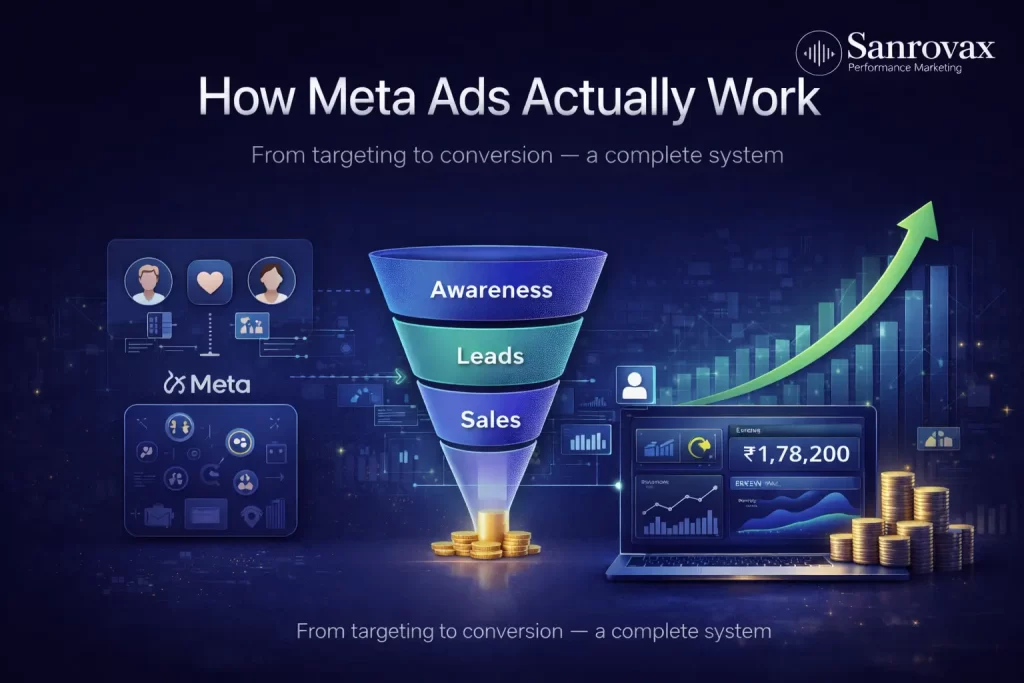
Understanding how Meta ads work is no longer optional if you run a business in 2026. It is the difference between growing predictably and hoping something sticks.
Introduction — Why Every Business Owner Needs to Understand How Meta Ads Work
Let me be honest with you.
If you are running a business today — whether it is a clinic, an e-commerce store, a coaching brand, or a local service — and you are not advertising on Meta, you are invisible to a very large portion of your potential customers. Not because your product is bad. But because your competitors are already there, and they are getting smarter every month.
Here is the reality in numbers.
Meta’s Family of Apps — Facebook, Instagram, WhatsApp, and Messenger — now has 3.58 billion daily active people as of December 2025. That is not monthly users. That is people showing up every single day. Meta’s full-year 2025 advertising revenue hit $200.97 billion, growing 22% year over year. Ad impressions across the platform increased by 18% in Q4 2025 alone, while the average price per ad rose by 6% — a clear signal that more businesses are competing for the same attention.
There are over 10 million active advertisers on Meta platforms right now. And this number only counts the businesses paying to run ads. The organic reach for business pages? It has been declining for years. If you are not paying for visibility on Meta, you are essentially whispering in a stadium full of people wearing headphones.
But here is what most business owners get wrong. They think Meta ads are complicated. They think it requires a huge budget. They think it is only for tech-savvy companies or massive brands with marketing teams.
None of that is true.
What is true is that understanding how Meta ads work — the system, the logic, the strategy behind it — is what separates businesses that waste money from businesses that generate real revenue. And that is exactly what this guide is going to give you. No jargon. No fluff. Just a clear, practical breakdown of how this platform actually works and how you can use it to grow.
Let us get into it.
What Are Meta Ads and How Do They Actually Work?
Before we talk about strategy, let us get crystal clear on the fundamentals. Because most business owners start running ads without truly understanding the machine they are putting their money into — and that is exactly how budgets get wasted.
What Are Meta Ads?
Meta ads are paid advertisements that appear across Meta’s family of apps — Facebook, Instagram, Messenger, and the Meta Audience Network (which extends your ads to third-party apps and websites). When you hear someone say “Facebook ads” or “Instagram ads,” they are talking about Meta ads. The platform was rebranded, but the advertising system runs under one unified dashboard called Meta Ads Manager.
You can use Meta ads to achieve almost any business goal — driving traffic to your website, generating leads, getting app installs, increasing sales, building brand awareness, or even getting people to visit your physical store. The platform does not care what industry you are in. It cares about one thing: matching the right ad to the right person at the right time.
The Auction System — How Meta Decides Which Ad to Show
This is where most people get confused, so let me explain it simply.
Meta does not work like a billboard where you pay a fixed price and your ad just sits there. It works on an auction-based system. Every time a user opens Facebook or Instagram, an auction happens in milliseconds to decide which ad that person will see. Thousands of advertisers might be competing for that one impression.
But — and this is the important part — the highest bidder does not always win.
Meta’s auction considers three things:
1. Your Bid — How much you are willing to pay for the desired action (a click, a lead, a purchase). You can set this manually or let Meta optimise it automatically.
2. Estimated Action Rate — Meta’s AI predicts how likely the user is to take the action you want. If your ad is relevant to the person seeing it, this score goes up — even if your bid is lower than a competitor’s.
3. Ad Quality and Relevance — Meta evaluates the quality of your ad based on user feedback, engagement patterns, and content. Ads that people hide, report, or ignore get penalised. Ads that people engage with get rewarded with lower costs.
This means a well-crafted, relevant ad with a moderate budget can outperform a lazy ad with a massive budget. The system is designed to reward relevance — not just spending power.
The Campaign Structure — Three Levels You Need to Understand
Meta Ads Manager organises everything into three levels:
Campaign Level — This is where you choose your objective. What do you want the ad to achieve? Options include Awareness, Traffic, Engagement, Leads, App Promotion, and Sales. The objective you choose tells Meta’s algorithm what kind of people to find.
Ad Set Level — This is where you define your audience, placements (where your ad appears), budget, and schedule. You can target people by location, age, gender, interests, behaviours, or use custom audiences from your own data.
Ad Level — This is where you build the actual creative — the image or video, the headline, the description, and the call-to-action button.
In 2026, Meta has pushed heavily toward Advantage+ automation at every level. The platform now handles much of the targeting and placement optimisation automatically using AI — specifically through its new Andromeda algorithm, which is 100x faster at matching people to ads than the previous system. The brands that are winning are the ones feeding the system diverse, high-quality creative and letting the AI do what it does best.
The bottom line? Meta ads work by putting your business in front of the exact people who are most likely to care about what you offer — and you only pay when they take action. It is not magic. It is math, data, and intelligent automation working together.
How Meta Ads Work — What to Keep in Mind When Running Campaigns
Knowing how Meta ads work is step one. Running them effectively is step two. Here are the things every business owner needs to keep in mind before spending a single rupee or dollar on Meta advertising.
1. Choose the Right Campaign Objective — It Changes Everything
This sounds basic, but it is the most common mistake. If you want leads but choose “Traffic” as your objective, Meta will find people who click — not people who fill out forms. Always match your campaign objective to your actual business goal. Want phone calls? Choose Leads. Want purchases? Choose Sales. The algorithm optimises for exactly what you tell it to.
2. Let Advantage+ Do Its Job — Stop Over-Controlling Targeting
In 2026, 82% of Facebook advertisers use Meta’s Advantage+ automation suite. There is a reason for that. The AI is better at finding your buyers than manual interest-based targeting in most cases. Give it broad audiences, feed it good creative, and let it learn. Over-restricting your audience is one of the fastest ways to increase your cost per result.
3. Creative Quality Is Your Biggest Lever
Under the Andromeda algorithm, your ad creative is the primary signal that determines who sees your ad. Meta’s visual recognition models analyse your images and videos to match them with the right audience. This means your creative is not just an ad — it is your targeting. Invest in diverse creative formats: UGC-style videos, carousel ads, vertical Reels content. In 2026, 90% of Meta’s ad inventory is vertical. If your ads are not designed for 9×16, you are leaving money on the table.
4. Install the Meta Pixel and Conversions API — Non-Negotiable
Without proper tracking, you are flying blind. The Meta Pixel tracks user actions on your website, and the Conversions API sends server-side data directly to Meta. Together, they give the algorithm the data it needs to optimise your campaigns. Between 35% and 60% of active advertisers now use the Conversions API alongside the pixel. If you are not one of them, your competitors have a data advantage over you.
5. Set Realistic Budgets and Give Campaigns Time to Learn
Meta’s algorithm needs data to optimise. If you kill a campaign after two days because you have not seen results, you have not given the system enough time to learn. For smaller advertisers, expect to spend at least $300–$600 before the algorithm collects enough data to outperform manual campaigns. Do not panic. Let the machine learn.
6. Mobile-First Is Not a Suggestion — It Is the Reality
94–98% of Meta’s ad traffic comes from mobile devices. Every ad you create needs to look great on a phone screen first. Vertical video, large readable text, fast-loading landing pages — these are not nice-to-haves. They are requirements.
7. Track the Right Metrics
Do not obsess over likes and impressions. The metrics that matter for business growth are: Cost Per Lead (CPL), Cost Per Acquisition (CPA), Return on Ad Spend (ROAS), Click-Through Rate (CTR), and Conversion Rate (CVR). A data-driven approach separates profitable campaigns from expensive experiments.
What NOT to Do When Running Meta Ads — Common Mistakes That Burn Budgets
Just as important as knowing what to do is knowing what to avoid. Here are the mistakes that cost business owners the most money on Meta.
1. Do Not Boost Posts and Call It a Strategy
Boosting a post from your Facebook page is not running an ad campaign. It gives you almost no control over targeting, placement, or optimisation. Always use Meta Ads Manager for real campaigns.
2. Do Not Use One Creative for Everything
If all your ads look the same — same image, same hook, slightly different text — Meta’s algorithm will pick one and ignore the rest. You need creative variation, not creative iteration. Different angles, different formats, different tones. Your ad library should look diverse, not repetitive.
3. Do Not Ignore Frequency and Fatigue
When the same people see your ad too many times, performance drops and costs rise. Keep an eye on your Cost Per 1,000 Reach (CPMr) — if it starts spiking, your creative is fatigued. The fix is not increasing budget. The fix is refreshing your creative.
4. Do Not Skip the Landing Page
Your ad is only half the equation. If someone clicks your ad and lands on a slow, confusing, or irrelevant page, they will bounce. And Meta tracks that bounce. It hurts your ad quality score, which increases your costs. Make sure your landing page matches your ad promise and loads fast on mobile.
5. Do Not Set and Forget
Meta ads are not a “set it and forget it” channel. The algorithm learns and changes, competitors enter and exit the auction, and creative fatigues over time. Review your campaigns weekly. Test new creatives monthly. Optimise continuously.
6. Do Not Restrict Placements Manually
Forcing your ads to show only on “Instagram Feed” or “Facebook Stories” limits the algorithm. Use All Placements or Advantage+ placements and let Meta decide where your ad performs best. For most advertisers, 60–80% of impressions will naturally serve on Instagram anyway.
7. Do Not Expect Overnight Results
Meta ads are not a slot machine. They are a system that gets smarter with time and data. If you are looking for instant results with zero patience, you will waste money. The businesses that win are the ones that commit to the process — test, learn, optimise, scale.
How Sanrovax Helps Businesses Generate Revenue with Meta Ads
At Sanrovax, we do not just “run ads.” We build performance marketing systems that turn ad spend into measurable business revenue.
Here is how we approach Meta ads for our clients:
We start with strategy, not settings. Before touching Ads Manager, we understand your business model, your customer journey, your margins, and what a real result actually looks like for you. Then we build a campaign structure designed to deliver that specific outcome — whether it is qualified leads, booked appointments, online sales, or store visits.
We handle the full system — from creative production (UGC-style videos, carousels, and Reels content designed for 2026’s vertical-first environment) to audience architecture, pixel and Conversions API setup, landing page alignment, and ongoing optimisation.
We track what matters — CPL, CPA, ROAS, and actual revenue impact — not vanity metrics. Every campaign we run is built to compound: better data feeds better targeting, which feeds better results, month after month.
Whether you are a small business spending your first ₹10,000 on ads or a scaling brand ready to invest seriously, we build systems that match your stage and your goals.
FAQ — How Meta Ads Work ❓
Q1: How much does it cost to run Meta ads?
There is no fixed cost. Meta ads work on an auction system, so your costs depend on your industry, audience, competition, and ad quality. For Indian businesses, the average cost per click ranges from ₹5 to ₹40 depending on the vertical. Globally, the average CPC across all industries is approximately $1.14 in 2026. You can start with as little as ₹500 per day and scale based on results.
Q2: Are Meta ads worth it for small businesses?
Absolutely. Between 30–45% of small and medium businesses run Facebook ads monthly in mature markets. The median monthly ad spend for SMBs on Meta platforms falls in the ₹15,000–₹90,000 range. With the right strategy and creative, even a small budget can generate consistent leads and sales. The key is proper tracking, relevant creative, and letting the algorithm learn.
Q3: What is the difference between Meta ads and Facebook ads?
They are essentially the same thing. When Facebook rebranded to Meta, the advertising platform was unified under the name “Meta Ads.” When you run Meta ads through Ads Manager, your ads can appear across Facebook, Instagram, Messenger, and the Audience Network — all from one dashboard.
Q4: How long does it take to see results from Meta ads?
For lead generation and traffic campaigns, you can start seeing initial data within 3–7 days. For meaningful optimisation and consistent results, expect 30–60 days. Meta’s AI needs enough conversion data to learn which audiences and placements perform best for your specific business. Patience and consistent creative testing are essential.
Q5: Can I run Meta ads without a website?
Yes. Meta offers Instant Forms (Lead Ads) that let users submit their contact information without ever leaving Facebook or Instagram. You can also drive traffic to a WhatsApp chat, a Messenger conversation, or your Instagram profile. However, having a website with proper tracking gives you significantly more data and better long-term results.
Q6: What type of ads work best on Meta in 2026?
Video content — especially vertical video designed for Reels and Stories — dominates in 2026. UGC-style content (user-generated, authentic-looking videos) consistently outperforms polished studio ads. Instagram Stories deliver 61% higher CTR compared to the Facebook Feed. The key is creative diversity: test different angles, formats, and hooks rather than running the same visual with minor text changes.
Conclusion — Stop Guessing, Start Building
If you have read this far, you now understand how Meta ads work better than most business owners ever will. You know the auction system, the campaign structure, the metrics that matter, and the mistakes that waste money.
But knowing is not the same as doing.
The businesses that win with Meta advertising in 2026 are not the ones with the biggest budgets. They are the ones with the clearest strategy, the best creative, and the discipline to optimise consistently. Meta’s AI is smarter than it has ever been — but it still needs a human who knows what a real business result looks like to point it in the right direction.
That is exactly what we do at Sanrovax.
Every engagement starts with one simple question: what does a real result actually look like for your business? Not impressions. Not clicks. Real revenue. Real leads. Real growth.
If you are ready to stop guessing and start building a Meta ads system that compounds every month, let us have a conversation.
Book Your Free 30-Minute Strategy Call → sanrovax.com
No pressure. No pitch. Just a clear, honest conversation about your business.
Sandip Sahani — Founder, Sanrovax Performance Marketing & Growth Systems | Halisahar, West Bengal, India sandip@sanrovax.com
17 thoughts on “How Meta Ads Work — Complete Guide for Business Owners (2026)”