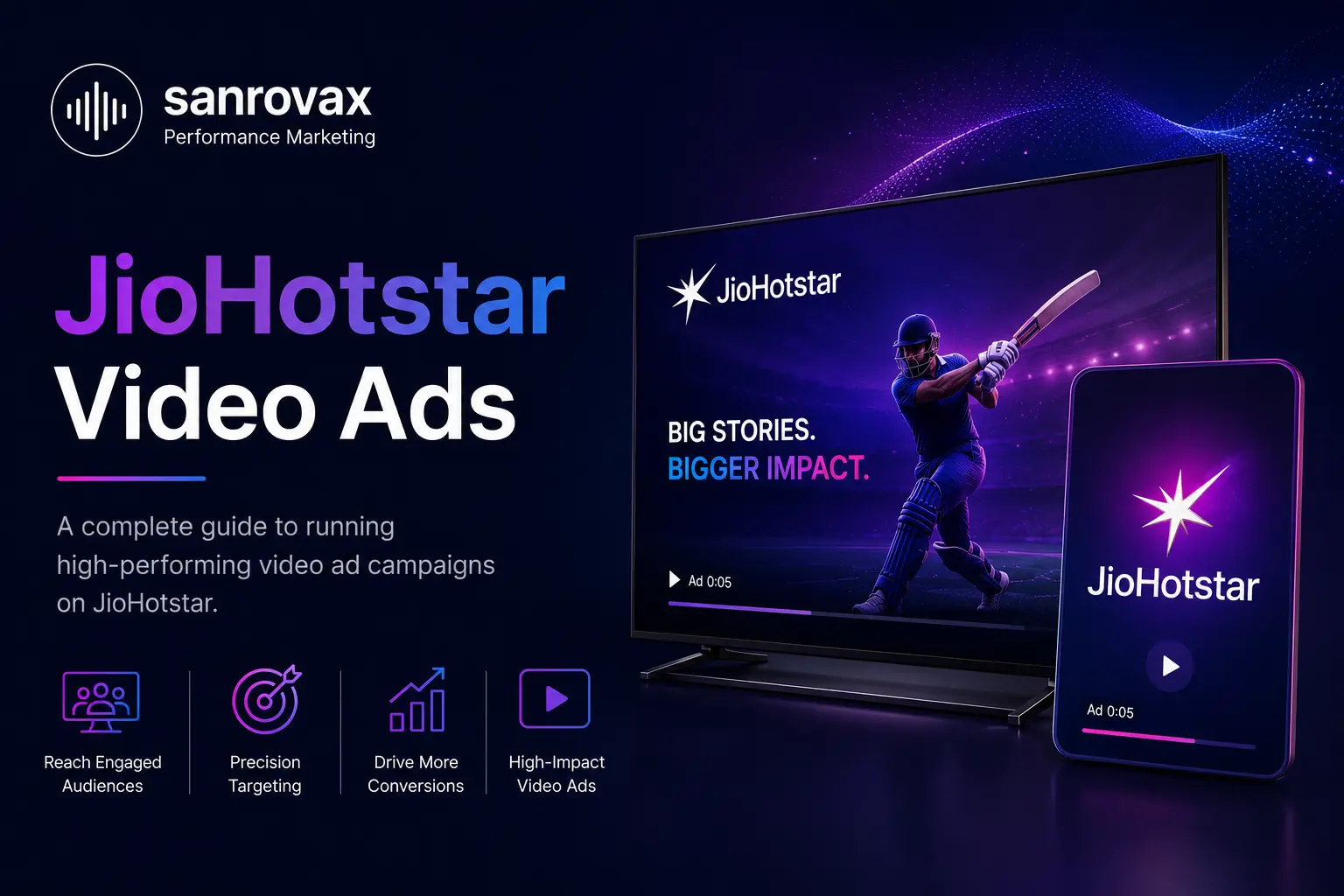
JioHotstar video ads are the most powerful in-stream advertising format on India’s largest OTT platform – and the format most Indian businesses underestimate before they run their first campaign. This guide covers everything: what the format is, all five sub-types, official pricing, targeting, creative specifications, CTV placements, IPL inventory, and the decision framework for when video is the right choice over display.
Introduction
Here is the fundamental difference between JioHotstar video ads and every other video advertising format available to Indian businesses in 2026.
When a user opens YouTube and sees your video ad, they are in a browsing or searching state – some are deeply engaged, others have the app running in the background, many are mid-scroll through a content feed. The same CPM buys impressions across all of those states simultaneously. You cannot distinguish the user who is paying full attention from the user who has effectively tuned out.
When a user opens JioHotstar and your JioHotstar video ads plays, the context is entirely different. That user opened the app with a specific intent – to watch something they chose. They are in a lean-forward, full-screen viewing session that averages 55 to 65 minutes per day per user. Your video plays before or during content they are actively, intentionally watching. The attention is not guaranteed by a technology constraint – it is earned by the viewing behavior itself.
This is the strategic case for JioHotstar video ads: not just reach, but reach in the highest-attention video environment available on any Indian digital platform.
The platform numbers support this positioning. JioHotstar has 550 million monthly active users in its total ecosystem, with 300 million monthly actives specifically on the OTT streaming side. 100 million of those users are paid subscribers – demonstrating willingness to pay for content, which is a proxy for the quality of engagement those sessions represent. During the ICC T20 World Cup Final, 72.5 million concurrent viewers watched simultaneously – a number that represents the largest simultaneous digital audience in Indian history.
And since 2026, JioHotstar video ads are available to any registered Indian business through the self-serve platform – starting at ₹315 CPM for L1 targeting, with a minimum campaign budget of ₹25,000 for video placements.
This guide covers the complete JioHotstar video ads picture in 2026: all five video formats, pre-roll versus mid-roll placement psychology, official pricing, targeting options, creative specifications, CTV advertising, IPL inventory, and the decision framework for when video is the right format choice versus the platform’s display alternatives.
JioHotstar Video Ads Kya Hote Hain?
JioHotstar video ads are in-stream video advertisements that play before content starts (pre-roll) or during content playback (mid-roll) across JioHotstar’s complete content library – sports, web series, movies, regional drama, news, and live events. They appear on mobile devices and on Connected TV (Smart TV) placements simultaneously, making them the only Indian digital advertising format that bridges mobile-first and living room television environments on a single platform.
The OTT Advertising Environment
Understanding what makes JioHotstar video ads different from other video advertising requires understanding what OTT (Over-The-Top) streaming advertising is – and why it is distinct from both digital and traditional television advertising.
Traditional television advertising places your video ad in a broadcast environment where viewership is measured by ratings and geographic reach is the primary targeting variable. You can target by channel and time slot – nothing more.
Digital social video advertising (YouTube, Instagram Reels, Meta) places your video ad in a user-generated or algorithm-driven content feed where attention varies significantly by moment, the environment is not brand-safe by default, and targeting is demographic or behavioral.
JioHotstar video ads occupy a third category: premium curated content in an on-demand environment with digital-level targeting precision. The content is entirely editorial – produced by studios, sports organizations, and professional content teams. There is no user-generated content on JioHotstar. Your video ad appears adjacent to a web series episode, a cricket match broadcast, or a Bollywood film – brand-safe by design, with targeting that can be as broad as national reach or as specific as users in individual PIN codes watching premium content in a specific language.
Platform Scale – Key Numbers
- Total ecosystem MAU: 550 million
- OTT monthly active users: 300 million+
- Paid subscribers: 100 million+
- Average daily session: 55–65 minutes
- Peak concurrent viewers: 72.5 million (ICC T20 WC Final)
- Content languages: 19
- Available placements: Mobile + Connected TV (Smart TV)
JioHotstar Video Ads – 5 Formats Explained
JioHotstar video ads are not a single format – they are a family of five distinct creative structures, each built for a different campaign purpose. Choosing the right format before creative production begins is essential – because the format determines what additional elements appear alongside your video and what user actions are available after viewing.
Format 1 – Video Without Companion
The purest JioHotstar video ads format. A full-screen video plays – pre-roll or mid-roll – with no additional display elements below the video player. The entire screen is your brand’s canvas for the duration of the ad.
This is the storytelling format. When your campaign objective is brand recall, emotional connection, or communicating a narrative that cannot be compressed into a product card and a button – Video Without Companion is the appropriate choice. There is no CTA button competing for visual attention. No product tiles distracting from the video. Just your brand’s video message in a full-screen environment with the complete viewing attention of a JioHotstar user who is settled in for content.
Best for: Brand films, emotional storytelling, campaign launches where the message requires full creative space, FMCG brand building, automotive aspiration campaigns, awareness campaigns where recall is the primary goal.
Format 2 – Video With CTA
JioHotstar video ads with CTA add a tappable Call-to-Action button that appears below the video player while the video plays. The button is visible throughout the ad duration – allowing users who are immediately interested to click through without waiting for the video to end.
The CTA button options include: Shop Now, Learn More, Book Now, Install Now, Apply Now, Get Quote, Contact Us. Each links to your designated landing URL.
This is the performance format among JioHotstar video ads – it combines the brand recall value of video with the direct response capability of a tappable conversion element. For campaigns where the goal is not only awareness but measurable downstream action, Video With CTA delivers both objectives from a single placement.
Best for: D2C brand awareness campaigns with conversion intent, app install campaigns that also need brand storytelling, healthcare brands running appointment booking campaigns, EdTech brands combining brand building with lead capture.
Format 3 – Video With Takeover
The dominant presence format. JioHotstar video ads With Takeover adds an expanded display panel below the video player – significantly larger than the CTA button format. This panel typically displays brand logo, a headline, product imagery, and brand identity elements alongside the video.
The visual effect is a comprehensive brand presence that occupies both the video space and a significant companion display area simultaneously. For product launches, competitive conquest campaigns, or high-impact moments where maximum brand ownership of the screen matters – Video With Takeover commands attention across the full vertical screen.
Best for: Major product launches, brand refresh campaigns, competitive moments where presence against category rivals matters, premium brand positioning where the combination of video storytelling and dominant display creates a premium brand signal.
Format 4 – Video With Carousel
JioHotstar video ads With Carousel add a swipeable row of product tiles below the video player while the video plays. Each tile in the carousel contains a product image and links to an individual product page. Users can swipe through the carousel while the video continues playing above.
This is the e-commerce format among JioHotstar video ads – combining the brand storytelling of video with the product discovery mechanics of a shoppable carousel. A fashion brand running a new collection campaign can display the brand’s campaign video above while the carousel below shows individual pieces from the collection, each linking directly to the product page.
Best for: D2C e-commerce brands with product catalogues, fashion and apparel collection launches, beauty brands showing product ranges, multi-product FMCG campaigns, any brand where the video communicates the brand story while the carousel enables immediate product exploration.
Format 5 – Video With Webview
The most immersive format in the JioHotstar video ads family. Video With Webview opens an in-app browser panel alongside the video – allowing users to browse a brand’s website, product page, or landing experience without leaving the JioHotstar app. The video continues playing in the upper portion of the screen while the webview occupies the lower panel.
This format is suited for brands with rich website experiences – real estate developers with virtual tours, automotive brands with configurators, hospitality brands with booking flows, or any brand where the conversion journey benefits from website depth rather than a single landing page.
Best for: Real estate developers (property browsing within the app), automotive brands (car configuration), hospitality and travel (booking flows), financial services (product exploration), any brand where the website itself is a meaningful part of the consideration experience.
Format Comparison at a Glance
| Format | Extra Element | Primary Goal | India CPM |
|---|---|---|---|
| Without Companion | None | Brand storytelling | ₹315 (L1) |
| With CTA | Tap button | Performance + awareness | ₹315 (L1) |
| With Takeover | Brand panel | Launch + dominance | ₹315 (L1) |
| With Carousel | Product tiles | E-commerce discovery | ₹315 (L1) |
| With Webview | In-app browser | Deep consideration | ₹315 (L1) |
Pre-Roll vs Mid-Roll – Kya Difference Hai?
All five JioHotstar video ads formats can run as pre-roll or mid-roll placements. The distinction matters – not because one is technically superior, but because the user’s psychological state differs between them, and matching your campaign objective to the right placement moment improves results.
Pre-Roll – The Anticipation Placement
Pre-roll JioHotstar video ads play before content begins – the user has selected what they want to watch and is waiting for it to start. The psychological state is anticipation: the user is primed for content consumption, attention is high, and the transition from ad to content is clear.
The pre-roll placement works well for direct offers, product launches, and short punchy messages that benefit from the clarity of a defined start moment. The user knows they are about to watch content; your ad plays first; content begins. This clarity makes pre-roll well-suited to messages that need to communicate quickly and cleanly.
Best for: Direct product offers, IPL moments where the cricket match is about to start, launch campaigns where being first matters, short-duration JioHotstar video ads (10–15 seconds).
Mid-Roll – The Commitment Placement
Mid-roll JioHotstar video ads play during content – after the user has already invested time watching. The psychological state is engagement: the user is committed to the content, has already decided this session is worth their attention, and is in a sustained viewing mode rather than a starting mode.
Mid-roll placements consistently generate higher video completion rates than pre-roll because the user is already in a settled, content-consumption state rather than a transition state. For brand storytelling campaigns where the message benefits from a viewer who is already in a viewing mindset – mid-roll has structural advantages.
During live sports like IPL, mid-roll placement at specific contextual moments – strategic timeouts, between overs, after wickets – captures peak emotional engagement when the audience is most alert and attentive.
Best for: Brand storytelling campaigns that benefit from higher completion rates, IPL live match advertising where contextual mid-roll placement creates brand-moment association, longer-duration JioHotstar video ads (30–60 seconds) that require sustained viewing.
The Practical Choice
For most JioHotstar video ads campaigns, the placement (pre-roll vs mid-roll) is determined by inventory availability and audience reach rather than advertiser preference alone. The self-serve platform optimizes delivery across both placements based on your targeting and budget parameters. For premium placement control – specific match moments during IPL, for example – direct placement management through Snap’s India sales team or an authorized agency partner is the appropriate route.
JioHotstar Video Ads – Official Cost (2026)
The official JioHotstar video ads pricing through the self-serve platform is CPM-based – you pay per 1,000 impressions.
Self-Serve Platform Pricing
| Targeting Tier | CPM | ₹25,000 Budget | ₹50,000 Budget |
|---|---|---|---|
| L1 (1 targeting dimension) | ₹315 | 79,000 impressions | 1.58 lakh |
| L2 (2 targeting dimensions) | ₹338 | 74,000 impressions | 1.48 lakh |
All figures excluding 18% GST.
L1 Targeting = One dimension active – Demographics OR Geographic OR Pincode. Wider reach within the chosen dimension. Lower CPM.
L2 Targeting = Two dimensions combined – Demographics + Geographic, or Geographic + Interest, etc. More precise audience definition. Slightly higher CPM.
For first JioHotstar video ads campaigns: L1 targeting is always the recommended starting point. More impressions per rupee, broader data collection, and sufficient reach to generate meaningful campaign learning.
IPL 2026 Video Ad Pricing
IPL inventory is premium – the demand is highest, the audience is largest, and the pricing reflects that:
- Mobile pre-roll (entry level): ₹180–₹200 CPM
- Premium match days: ₹340–₹360 CPM
- Entry budget for IPL: ₹5 lakh minimum
- Peak concurrent audience: 72.5 million (ICC T20 WC Final benchmark)
Note: IPL CPMs appearing lower than standard video CPM reflects different inventory structures – IPL packages are typically sold differently from standard self-serve campaigns and include reach and frequency guarantees that standard campaigns do not.
CTV (Connected TV) Video Ad Pricing
JioHotstar video ads on Smart TV placements command a different price range:
- Standard CTV targeting: ₹180–₹300 CPM
- Premium CTV (high-impact): ₹400–₹550+ CPM
- Best for: Premium household reach, family viewing environment, brand recall in the living room
Budget Planning – What Different Budgets Get You
| Monthly Budget (ex-GST) | Format | Approximate Impressions |
|---|---|---|
| ₹25,000 | L1 Video | 79,000 |
| ₹50,000 | L1 Video | 1.58 lakh |
| ₹1,00,000 | L1 Video | 3.17 lakh |
| ₹2,00,000 | L2 Video | 5.9 lakh |
| ₹5,00,000 | L2 Video + CTV | 14+ lakh combined |
GST calculation: Every figure above requires 18% addition at payment. ₹25,000 campaign = ₹29,500 actual wallet charge.
Video vs Fence – The Cost Comparison That Matters
JioHotstar video ads at ₹315 CPM versus Fence Display ads at ₹90 CPM – a 3.5x cost difference. This comparison is the most important budget decision on the platform, and it has a clear answer:
Video ads = storytelling, brand recall, emotional connection, product demonstration. The format requires a produced video creative and rewards campaigns where the message cannot be compressed into a static image and a headline.
Fence ads = display visibility during playback, non-interruptive, accessible at lower CPM for awareness campaigns and at ₹9 CPC for traffic campaigns. Best when the goal is reach volume or clickable traffic rather than storytelling.
The decision is not “which is cheaper” – it is “which format does what my campaign actually needs to accomplish?”
For the complete pricing picture across all formats, see our detailed guide: JioHotstar Ads Cost — Complete Pricing Guide.
JioHotstar Video Ads – Targeting Options
JioHotstar video ads use the same targeting infrastructure as all JioHotstar self-serve campaigns. For video specifically, content targeting is an additional layer unavailable in display formats.
Standard Targeting
Age: Custom age range. Do not default to all ages – specific ranges reduce wasted impressions on demographics outside your customer profile.
Gender: Female, Male, or both. Simple but impactful – a men’s health brand running all-gender targeting wastes half its impressions on an audience that will not convert.
State: Target specific Indian states. For regional brands, 2–3 states significantly outperforms All India for CPM efficiency.
City: City-level precision within selected states. Most effective for brands with urban-concentrated audiences or city-specific distribution.
PIN Codes: The most hyperlocal targeting dimension on the platform – individual PIN codes or bulk upload. Particularly relevant when JioHotstar video ads are used for local business awareness campaigns in specific geographic catchments.
Advanced Targeting (Toggle On)
Interests: Target users based on their content consumption patterns on JioHotstar:
- Sports (cricket, football, kabaddi, live sports viewers)
- Drama (Indian GEC, regional drama)
- Movies (Bollywood, Hollywood, regional)
- News
- Lifestyle
- Kids
Subscription Level: Premium subscribers (paid users) versus Free tier. For luxury brands, premium financial products, and aspirational categories – Premium subscriber targeting reaches users who have demonstrated willingness to pay.
Socio-Economic Status: Income and lifestyle segmentation for brands where socioeconomic targeting is relevant.
Device Price: A proxy for disposable income – useful for premium brands wanting to exclude entry-level device users.
Frequency Cap: Daily maximum exposures per user. For JioHotstar video ads, 3–5 exposures per day per user is the recommended maximum to maintain recall without causing ad fatigue.
Content Targeting – Video-Specific
Content targeting allows your JioHotstar video ads to appear only alongside specific programming:
Across General Entertainment Content: Maximum reach across JioHotstar’s full library. Broad contextual relevance.
Specific Content Packages:
- Top Hindi GEC Shows (Bigg Boss, Star Plus shows)
- IPL matches (specific match types or full season)
- Regional language drama (Tamil, Telugu, Bengali, etc.)
- Bollywood movies (specific genre or rating tiers)
- Sports non-cricket (football, kabaddi, tennis)
- News content
Content-specific packages each carry their own pricing – typically premium over general entertainment CPM. The trade-off is contextual alignment: your brand appears specifically in the viewing context most relevant to your target audience.
L1 vs L2 – The Targeting Decision
For first campaigns: L1 always. ₹315 CPM, one dimension, maximum reach within chosen parameter, more impressions for the algorithm to optimize delivery.
For subsequent campaigns: L2 after 14+ days of L1 campaign data shows which targeting dimension is generating your best response. Combine the two strongest dimensions for L2 precision at ₹338 CPM.
JioHotstar Video Ads – Creative Specifications
JioHotstar video ads creative specifications are specific – and non-compliance means creative rejection, which means campaign delay. Review specifications before creative production begins, not after.
Technical Specifications
Duration:
- Standard: 10 seconds (most common for self-serve campaigns)
- Extended: Up to 60 seconds (longer formats for brand films and content-specific packages)
- Recommended for most campaigns: 15–30 seconds
FPS (Frames Per Second): This is the most commonly missed specification for JioHotstar video ads. Use JioHotstar’s Video FPS Tool (available in the platform’s Creative section) to process your video file to the correct frame rate before upload. Submitting at incorrect FPS causes rejection – and the rejection reason is not always immediately clear to first-time advertisers.
Aspect Ratio:
- Mobile placements: 16:9 horizontal (standard video) or 9:16 vertical (for specific mobile-optimized formats)
- CTV placements: 16:9 horizontal – mandatory for Connected TV
- Always check format-specific requirements in the platform’s creative specs tool
File Format: MP4 or MOV
Resolution: HD minimum (1280×720). Full HD (1920×1080) recommended for CTV placements where the large screen amplifies production quality differences.
File Size: Per JioHotstar’s current platform specifications – check the self-serve portal for current limits.
Creative Principles for JioHotstar Video Ads
The First 3 Seconds Rule
This is the most important creative principle for JioHotstar video ads: communicate your brand and core message in the first 3 seconds. Not the brand name in second 8. Not the offer revealed at second 12. Brand + key message + visual identity – in the first 3 seconds.
Why: Pre-roll placements on JioHotstar are typically skippable after a duration threshold. Even in non-skippable formats, the user’s brain makes an immediate classification decision: “Is this relevant to me?” That decision happens in the first 3 seconds. If your first frame is a logo animation or a slow scene-setting shot, you have lost the window to establish relevance before the user has mentally disengaged.
Sound-On Platform – Critical Design Principle
JioHotstar is a sound-on environment. This is fundamentally different from Instagram Reels and Facebook Feed, where 80%+ of content is watched silently and effective ads are designed to communicate without sound.
JioHotstar video ads are watched by users who are in an active content viewing session – they opened the app to watch something, they have sound on, and they are engaged. Your creative should be designed with sound as a primary communication channel, not a nice-to-have addition.
This means:
- Voiceover or music that carries meaningful brand messaging
- Sound design that reinforces the visual message
- Hindi or regional language voiceover for campaigns targeting non-English-dominant audiences (consistent with JioHotstar’s regional content consumption patterns)
Subtitles for Regional Targeting
For JioHotstar video ads targeting regional language audiences – Tamil, Telugu, Bengali, Kannada, Malayalam, Marathi — subtitles in the relevant language are not optional. They are essential for message comprehension and significantly improve completion rates in regional language targeting contexts.
Creative Refresh – The 7–14 Day Rule
JioHotstar’s delivery algorithm penalises stale creative. A JioHotstar video ads creative running beyond 14 days without refresh experiences rising CPMs and declining completion rates as the algorithm loses confidence in the creative’s relevance. Plan a creative refresh cycle before campaign launch – not as a reactive measure after performance declines.
Common Creative Mistakes to Avoid
❌ Logo animation as the opening frame – brand identity in seconds 0–3, not second 8
❌ Text-heavy creative – JioHotstar users are watching, not reading
❌ Horizontal creative for mobile-first campaign without verification – check placement specs
❌ No CTA in final 3 seconds – tell users what to do next before the ad ends
❌ Silent creative on a sound-on platform – design with audio intention
❌ Same creative beyond 14 days – refresh proactively
✅ Product or offer visible in first 3 seconds
✅ Clear visual hierarchy – one primary message per frame
✅ Intentional sound design – voiceover, music, or both
✅ Regional language where targeting demands it
✅ CTA in final 3 seconds – consistent with the CTA button format if using Video With CTA
✅ Subtitles for regional audiences
JioHotstar Video Ads on CTV (Connected TV)
Connected TV is the fastest-growing placement surface for JioHotstar video ads in India – and the one most underplanned for by Indian advertisers.
What CTV Advertising Means
CTV (Connected TV) advertising refers to JioHotstar video ads served on Smart TVs – the JioHotstar app running on a television screen via an internet connection. As Smart TV penetration grows in Indian urban and semi-urban households, CTV represents a bridge between the targeting precision of digital advertising and the screen size and household-viewing context of traditional television.
Why CTV Matters for Indian Brands
The largest screen in the house: A 40–65 inch television displaying your JioHotstar video ads at full resolution, with household audio, creates a brand impression that no mobile phone screen can replicate. For categories where brand stature matters – automotive, FMCG, financial services, real estate – the CTV environment signals premium brand presence in a way that mobile advertising cannot.
Family viewing unit: Smart TV content in Indian households is often watched by multiple family members simultaneously. A single CTV impression may reach 2–4 viewers – the household decision-making unit for many high-ticket purchase categories. For brands targeting family purchase decisions (cars, home appliances, real estate, insurance), CTV delivers the decision-relevant audience together.
Premium household indicator: Smart TV penetration in India correlates with higher-income urban and semi-urban households — the same demographic most relevant to premium consumer brands, luxury D2C, financial products, and aspirational categories.
CTV vs Mobile – Format Differences
| Factor | CTV Placement | Mobile Placement |
|---|---|---|
| Screen size | 40–65 inch | 5–7 inch |
| Viewers per impression | 1–4 (family) | 1 (individual) |
| CPM | ₹180–₹550+ | ₹315 |
| Completion rate | Higher | High |
| CTA interaction | Limited (remote) | Tap-enabled |
| Production expectation | Higher quality | Any quality |
| Best for | Brand awareness/recall | Awareness + performance |
CTV Creative Requirements
JioHotstar video ads for CTV placements require specific creative considerations:
- 16:9 horizontal format is mandatory – no vertical video on CTV placements
- Higher production quality is expected – the 50-inch screen amplifies production quality differences in ways that mobile placements do not
- No mobile-specific CTAs – “Swipe up,” “Tap below,” and similar mobile-interaction CTAs are meaningless on a remote-controlled TV interface
- Family-appropriate content – CTV is a shared screen, not a personal device. Creative must be suitable for all ages in a household
CTV Pricing
JioHotstar video ads CTV CPMs range from ₹180–₹300 for standard CTV targeting to ₹400–₹550+ for premium placements and high-demand inventory. Final CTV pricing depends on targeting depth, content placement, and seasonality – IPL on CTV commands the highest premium inventory rates.
JioHotstar Video Ads During IPL
IPL (Indian Premier League) on JioHotstar is the single largest annual advertising moment in Indian digital media – and the context in which JioHotstar video ads reach their peak audience concentration, peak emotional engagement, and peak competitive pricing.
The IPL Advertising Opportunity
During IPL 2026, JioHotstar streams every match to an audience that peaks at tens of millions of concurrent viewers. The 72.5 million concurrent viewer record set during the ICC T20 World Cup Final represents the scale ceiling – IPL season consistently approaches these numbers for marquee matches.
The audience profile during cricket on JioHotstar is distinctive: male-dominant (75%), strongly concentrated in the 25–44 age bracket, urban and semi-urban, and exhibiting the sustained, undivided viewing attention of live sports fans following a match ball by ball. For brands targeting this demographic – automotive, FMCG, financial services, telecom, consumer durables – there is no comparable concentration of relevant audience on any other Indian digital platform.
IPL 2026 Video Ad Pricing
- Mobile pre-roll (entry level): ₹180–₹200 CPM
- Premium match days (semifinals, finals): ₹340–₹360 CPM
- CTV during IPL: Higher premium rates
- Minimum budget for IPL campaigns: ₹5 lakh
- IPL Starter Package: ₹15,00,000 (excluding GST) — managed through Snap’s India sales team or authorized agency
IPL Video Ad Placement Moments
Unlike regular content where pre-roll and mid-roll are the primary placement types, IPL live match JioHotstar video ads can be placed at specific contextual match moments:
- Pre-match – high anticipation, players arriving, lineups being announced
- Player walk-in – maximum visual attention on the field
- Between overs – natural content break, brief pause in action
- Strategic timeout – mandated break, viewer attention sustained
- Post-wicket – emotional peak moment immediately after a wicket falls
- Innings break – longest content break, maximum ad delivery window
- Match result – post-result emotional moment (win/loss)
Brand association with specific match moments — a FMCG brand appearing consistently during strategic timeouts, for example – creates contextual brand-moment linkage in the viewer’s memory that extends beyond the ad exposure itself.
Planning IPL JioHotstar Video Ads
For brands considering IPL advertising through JioHotstar video ads:
Entry via self-serve: The platform’s standard video CPM applies to general IPL inventory through the self-serve portal. For specific match selection, moment-based placement, and premium IPL packages – direct engagement with JioHotstar’s advertising team or an authorized agency partner (like Sanrovax) provides access to managed IPL inventory with campaign support.
Lead time: IPL inventory is limited and sells out early for premium packages. Planning 60–90 days before IPL season begins is appropriate for managed campaigns. Self-serve campaigns can be created closer to match dates subject to availability.
Which Businesses Should Run JioHotstar Video Ads?
JioHotstar video ads are the right format choice when the campaign requires storytelling — when a static image and a headline are insufficient to communicate the message, create the emotion, or demonstrate the product.
Must Run
FMCG Brands: Mass consumer categories – personal care, packaged foods, household products – where the campaign goal is nationwide brand recognition at scale. JioHotstar video ads deliver the reach and frequency that television previously owned, with digital-level audience targeting precision.
Automotive Brands: The aspirational communication that automotive advertising requires – the product in motion, the lifestyle it represents, the design revealed – cannot be adequately expressed in a static banner. Pre-roll JioHotstar video ads during cricket season, when the target demographic (male, 25–44) is most concentrated and attentive, delivers automotive brand messages at peak receptivity.
D2C Brands with a Story: Products that need context – how they are made, why they are different, what experience they create – benefit from the narrative space that JioHotstar video ads provide. A D2C brand competing on story and brand values needs video; a static display ad at ₹90 CPM does not communicate what the video can.
Financial Services: Insurance, banking, and investment products that require trust-building before conversion benefit from brand recall video exposure before the user is in a search-and-compare mode. JioHotstar video ads reach the financially relevant 25–44 demographic in a high-quality, brand-safe environment aligned with the credibility these categories require.
Healthcare Hospitals and Specialty Clinics: Brand awareness campaigns for multi-specialty hospitals, cancer centers, fertility clinics, and healthcare brands where brand trust is the purchase driver use JioHotstar video ads to build recognition and credibility in the OTT environment’s premium, brand-safe context.
Real Estate Developers: Project launches, township announcements, and lifestyle real estate campaigns require visual storytelling – the property, the surroundings, the lifestyle it represents. JioHotstar video ads reach the urban, premium-income demographic that represents the real estate buyer profile.
EdTech and Coaching: Concept demonstration, instructor credibility, curriculum storytelling – categories where the product needs to be shown, not just described.
Use Fence Ads Instead When
Goal is website traffic/clicks: JioHotstar’s Fence CPC format at ₹9 per click delivers website traffic far more cost-efficiently than JioHotstar video ads at ₹315 CPM. If the campaign objective is clicks, not brand storytelling – Fence CPC is the correct format.
Budget is below ₹25,000: The minimum practical budget for JioHotstar video ads campaigns is ₹25,000 (plus 18% GST). Below that threshold, Fence CPM at ₹90 delivers significantly more impressions per rupee for awareness objectives, and Fence CPC at ₹10,000 minimum delivers clicks for performance objectives.
No video creative available: Running a substandard video as a JioHotstar video ads campaign delivers worse results than a strong Fence display creative. If high-quality video cannot be produced, invest in strong display creative for Fence placements until video production is ready.
For the complete guide to Fence Ads, see: JioHotstar Fence Ads – Complete Guide.
JioHotstar Video Ads vs YouTube Video Ads
The comparison between JioHotstar video ads and YouTube video advertising is the most common strategic question for Indian brands evaluating video budgets. Here is the honest comparison:
| Factor | JioHotstar Video Ads | YouTube Video Ads India |
|---|---|---|
| Content environment | Curated editorial OTT | UGC + Premium mixed |
| Average session | 55–65 minutes focused | Variable |
| CPM India | ₹315 (self-serve L1) | ₹50–₹150 standard |
| Brand safety | 100% editorial guarantee | Brand suitability tools |
| CTV inventory | Strong India reach | Limited India |
| Skip option | Format-dependent | After 5 seconds (skippable) |
| Search intent capture | No | Yes (In-Feed) |
| Shorts format | No | Yes |
| Best for | Brand recall, premium audience | Performance, search intent |
The key insight: JioHotstar video ads and YouTube video advertising are not competing for the same campaign objective. JioHotstar is the premium brand-recall video environment. YouTube is the search-intent and algorithm-discovery video environment. The brands running both — with JioHotstar for OTT awareness and YouTube for consideration and performance – consistently outperform brands that choose one exclusively.
For the complete head-to-head analysis, see our detailed comparison: JioHotstar vs YouTube Ads — Which Platform Wins for Indian Businesses?
Expert Insight – Sandip Sahani, Founder, Sanrovax
“The question I get most often about JioHotstar video ads is whether the ₹315 CPM is justified compared to the platform’s Fence Ads at ₹90 CPM. It is the right question – and the answer is not ‘yes’ or ‘no.’ It is ‘it depends on what you need the campaign to do.’
Fence Ads at ₹90 CPM deliver brand visibility efficiently for campaigns where the message is simple enough that a static image and a headline communicate it completely. For a local clinic promoting appointment booking – Fence CTA with PIN code targeting at ₹9 CPC is far more efficient than JioHotstar video ads at ₹315 CPM. The clinic does not have a story to tell. It has a service to offer and a phone number to share.
But for a D2C skincare brand whose product is a routine, not just a single product – for a health insurance brand whose campaign is about family protection, not just a premium number – for a real estate developer whose project needs to create aspiration, not just convey specifications – the ₹315 CPM for JioHotstar video ads is not expensive. It is appropriate. Because the storytelling that video enables is what actually moves those audiences from awareness to consideration.
The other thing I consistently tell brands: JioHotstar is a sound-on platform. This is not a minor detail. The brands producing JioHotstar video ads with the assumption that they will be watched silently – because that is how their Meta ads are consumed – are leaving half the medium’s communication capacity unused. Design the audio as deliberately as the visual. Your brand is speaking to someone who is listening.”
– Sandip Sahani, Founder, Sanrovax | Authorized JioHotstar Advertising Partner
Sanrovax is a performance marketing and growth systems agency based in Halisahar, West Bengal, India, working with Indian and Australian businesses on Meta Ads, Google Ads, YouTube, JioHotstar, and full-funnel growth systems.
How Sanrovax Helps with JioHotstar Video Ads
At Sanrovax, JioHotstar video ads management starts with the format decision – not the campaign setup. Before any creative is briefed or any budget is committed, we determine whether video is the right format for the campaign’s specific objective, or whether Fence Ads (display or CPC) better serve what the campaign needs to accomplish.
When video is the right choice, we manage the complete process: creative brief development (including FPS processing guidance, sound design direction, first-3-seconds structure, and regional language considerations), campaign setup in Ads Manager, targeting configuration (L1 for first campaigns, L2 refinement for subsequent campaigns based on performance data), Pixel integration for conversion tracking, and weekly optimization cycles including creative refresh scheduling.
As an authorized JioHotstar advertising partner, we have access to the platform’s campaign infrastructure and the performance data from multiple client campaigns across different Indian business categories. The JioHotstar video ads guidance in this article reflects direct platform experience – not documentation reading.
For brands evaluating IPL advertising specifically, we provide inventory planning support – advising on which IPL packages align with brand objectives and budget levels, managing the campaign setup process, and monitoring delivery during the match season.
Whether your brand is considering JioHotstar video ads for the first time with a ₹25,000 test campaign or planning a ₹50 lakh IPL season investment, the starting point is always the same conversation: what does this campaign actually need to accomplish, and is video the format that accomplishes it most effectively?
FAQ – JioHotstar Video Ads
Q1: JioHotstar video ads ka CPM kitna hai 2026 mein?
JioHotstar video ads CPM through the self-serve platform in 2026 is ₹315 for L1 targeting (one dimension) and ₹338 for L2 targeting (two dimensions combined). All figures are excluding 18% GST – a ₹25,000 campaign costs ₹29,500 after GST. IPL 2026 mobile pre-roll starts at ₹180–₹200 CPM for entry-level packages, with premium match days reaching ₹340–₹360 CPM. CTV placements range from ₹180–₹550+ CPM.
Q2: JioHotstar video ads mein pre-roll aur mid-roll mein kya fark hai?
Pre-roll JioHotstar video ads play before content starts – the user is in anticipation mode, waiting for content to begin. Mid-roll plays during content – the user is already engaged and in a committed viewing state. Mid-roll typically generates higher video completion rates because the user has already invested time in the session. Pre-roll works well for direct offers and short messages; mid-roll works well for brand storytelling and longer-format creative.
Q3: JioHotstar video ads ke liye minimum budget kitna chahiye?
The minimum practical budget for JioHotstar video ads through the self-serve platform is ₹25,000 (excluding 18% GST – actual payment ₹29,500). At L1 targeting and ₹315 CPM, this delivers approximately 79,000 impressions. For IPL-specific campaigns, the minimum budget is ₹5 lakh for managed packages. The platform’s confirmed minimum campaign budget is ₹4,000 – but ₹25,000 is the practical floor for video campaigns to generate enough impressions for meaningful performance data.
Q4: JioHotstar video ads aur fence ads mein kya choose karein?
Choose JioHotstar video ads (₹315 CPM) when your campaign requires storytelling — when a static image and headline cannot communicate the message. Choose Fence Ads (₹90 CPM or ₹9 CPC) when your goal is reach volume at lower CPM or website traffic clicks. Video = narrative, emotion, demonstration. Fence = display visibility, traffic. Different formats for different campaign objectives – not different quality tiers.
Q5: JioHotstar video ad ki duration kitni honi chahiye?
The standard duration for self-serve JioHotstar video ads is 10 seconds. Extended formats up to 60 seconds are available. For most campaigns, 15–30 seconds is the optimal range – long enough to communicate a meaningful brand message, short enough to maintain completion rates. The critical principle: regardless of total duration, the brand and core message must appear in the first 3 seconds.
Q6: CTV pe JioHotstar video ads kaise kaam karte hain?
JioHotstar video ads on CTV (Connected TV) serve to Smart TV households through the JioHotstar app on a television screen. The format is 16:9 horizontal (mandatory for CTV), requires higher production quality than mobile, and reaches a family viewing unit rather than an individual. CTV placements deliver the largest-screen brand experience available in Indian digital advertising. CPM ranges from ₹180–₹550+ depending on targeting and inventory quality.
Q7: IPL pe JioHotstar video ads ka CPM kitna hai?
IPL 2026 JioHotstar video ads mobile CPM starts at ₹180–₹200 for entry-level packages and reaches ₹340–₹360 CPM for premium match days (semifinals, finals). The minimum budget for IPL managed campaigns is ₹5 lakh. For the full IPL Starter Package (managed with dedicated support), the entry is ₹15,00,000 excluding GST. IPL inventory is limited and premium – early booking is essential for peak match placement.
Q8: JioHotstar video ads ke liye creative specifications kya hain?
JioHotstar video ads creative requirements: video duration 10–60 seconds (standard 10 seconds for self-serve), correct FPS using JioHotstar’s Video FPS Tool (critical – incorrect FPS causes rejection), file format MP4 or MOV, HD resolution minimum (Full HD for CTV), 16:9 aspect ratio for standard placements. Creative principle requirements: brand visible in first 3 seconds, sound-on design (JioHotstar is a sound-on platform), subtitles for regional language targeting, creative refresh every 7–14 days.
Q9: JioHotstar video ads ke results kab dikhte hain?
JioHotstar video ads campaign data (impressions, clicks, CTR) appears in the Performance Trends dashboard within 24 hours of campaign going live. Meaningful performance data – enough to assess creative and targeting effectiveness – requires 7–14 days minimum. Brand recall impact from video advertising typically measures over 30–60 days as frequency builds. Do not assess creative performance or make optimization changes before 14 days of data collection.
Q10: Kya small businesses JioHotstar video ads run kar sakte hain?
Yes, with one important caveat: JioHotstar video ads require a video creative, a ₹25,000 minimum budget per campaign, and GST registration for billing. Small businesses with these resources can access the self-serve platform. However, small businesses whose goal is website traffic or hyperlocal leads may find Fence CPC campaigns (starting at ₹10,000, ₹9 per click with PIN code targeting) more cost-efficient than video CPM campaigns. The format choice should match the objective – not just the budget.
Conclusion – JioHotstar Video Ads: Premium Attention at Premium Investment
JioHotstar video ads are the highest-attention video advertising format available to Indian brands in 2026. The platform’s 55–65 minute average daily session, 100 million paid subscribers, 72.5 million peak concurrent viewers, and fully editorial brand-safe environment create a video advertising context that no other Indian digital platform replicates.
The format serves a specific purpose – storytelling, brand recall, product demonstration, emotional brand building – that static display formats cannot accomplish and that social video formats deliver with less attention guarantee.
The decision framework for JioHotstar video ads is simple:
Story dikhani hai? → Video Without Companion. Traffic bhi chahiye? → Video With CTA. Launch moment hai? → Video With Takeover. Multi-product showcase? → Video With Carousel. Website depth dikhani hai? → Video With Webview. IPL moment capture karna hai? → Pre-roll during strategic match moments. Living room household reach? → CTV placements.
And the format counter-decision: if the goal is clicks, not storytelling – Fence CPC at ₹9 is more efficient. If the budget is below ₹25,000 – Fence CPM at ₹90 delivers more impressions per rupee. JioHotstar video ads are premium – they should be deployed for campaigns where that premium is justified by the storytelling requirement.
At Sanrovax, we help Indian businesses determine when that justification exists – and when it does not. Every rupee of video budget should do the job that video is designed to do.
Book Your Free 30-Minute Strategy Call → sanrovax.com
Key Statistics – JioHotstar Video Ads 2026
- Video CPM (L1): ₹315 (excluding 18% GST)
- Video CPM (L2): ₹338 (excluding 18% GST)
- IPL mobile CPM (entry): ₹180–₹200
- IPL mobile CPM (premium): ₹340–₹360
- CTV CPM range: ₹180–₹550+
- Minimum video campaign budget: ₹25,000
- Average daily session: 55–65 minutes
- Peak concurrent viewers: 72.5 million (ICC T20 WC Final)
- OTT monthly actives: 300 million+
- Paid subscribers: 100 million+
- Total ecosystem MAU: 550 million
- Content languages: 19
- Video formats: 5 (Without Companion, With CTA, With Takeover, With Carousel, With Webview)
Sources: JioHotstar Self-Serve Platform 2026, TheMediaAnt JioHotstar Video Ad Cost, SYNOR JioHotstar Small Business Guide May 2026, eMarketters JioHotstar Advertising Cost 5 June 2026, SocioLabs JioHotstar Advertising Cost May 2026
Data compiled by Sandip Sahani, Founder, Sanrovax – Performance Marketing & Growth Systems | sanrovax.com
Internal Links:
- How to Advertise on JioHotstar
- JioHotstar Ads Cost — Complete Pricing Guide
- JioHotstar Fence Ads — Complete Guide
- JioHotstar Self Serve Ads — Setup Guide
- JioHotstar Self Serve Ads Tutorial
- JioHotstar vs YouTube Ads
- How to Create JioHotstar Ad Campaign
Sandip Sahani – Founder, Sanrovax Performance Marketing & Growth Systems | Halisahar, West Bengal, India sandip@sanrovax.com
4 thoughts on “JioHotstar Video Ads – Complete Guide to In-Stream Advertising on India’s Biggest OTT (2026)”