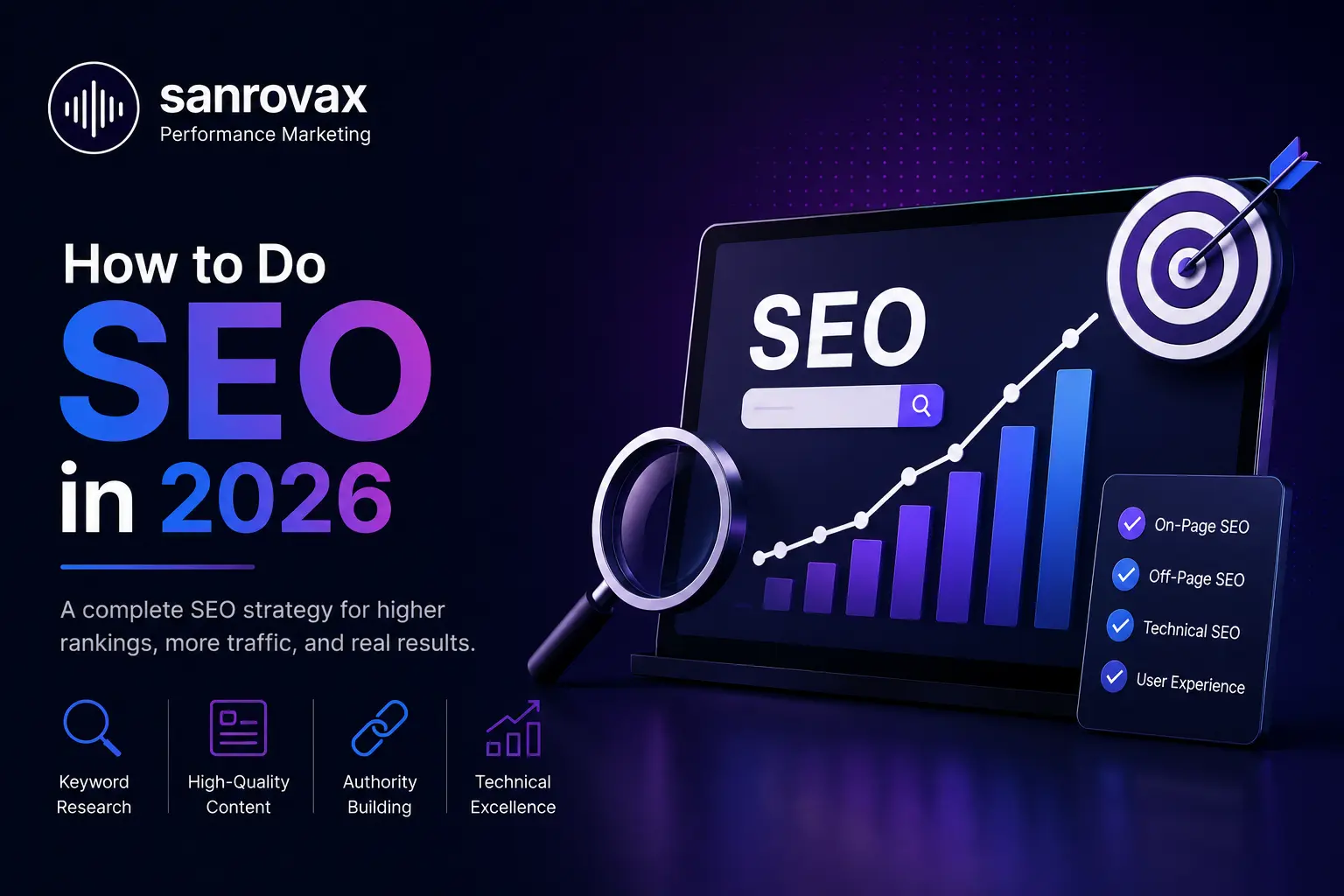
By Sandip Sahani, Founder, Sanrovax
Search engines do not work the way they did even two years ago, and if you are trying to understand how to do SEO in 2026, that shift is the first thing you need to accept. Google now blends organic listings with AI generated answers, voice results, and instant summaries that often skip the click altogether. SEO in 2026 is no longer a checklist of keywords and backlinks. It is a mix of technical health, genuine expertise, and content that both humans and machines can trust. This guide walks through exactly how to do SEO in 2026, step by step, without the outdated tactics that quietly hurt more than they help.
What SEO Actually Means in 2026
SEO stands for Search Engine Optimization, the practice of shaping a website so search engines can find it, understand it, and recommend it to the right person. That basic definition has not changed. What has changed is where those recommendations actually show up. A search today might return ten blue links, or it might return a single AI generated paragraph pulled from a handful of trusted sources, with no links at all. Ranking for SEO in 2026 means earning a place in both worlds at the same time.
Google’s systems now reward three things above almost everything else, relevance to what the searcher actually wants, technical soundness of the website, and clear evidence that the content was written by someone who genuinely understands the subject. This last point, often shortened to EEAT (Experience, Expertise, Authoritativeness, Trustworthiness), has quietly become the deciding factor between a page that ranks and one that quietly disappears from results.
If there is one mindset shift every business owner needs before learning how to do SEO in 2026, it is this. SEO is no longer about tricking an algorithm. It is about proving, in a way both people and machines can verify, that your content is worth trusting.
Step by Step SEO Process for 2026
Step 1: Keyword Research Built Around Intent
Keyword research in 2026 is not about stuffing a page with the highest volume term you can find. It starts with one simple question, what does the person typing this search actually want. Someone searching for SEO tips wants a guide. Someone searching for an SEO agency wants to hire someone. Mixing these two intents on a single page confuses both the reader and the algorithm.
Group your keywords by intent first, then by topic. Tools like Google Keyword Planner, Ahrefs, or Semrush will show you search volume, but volume alone is a weak signal on its own. A keyword with two hundred monthly searches and clear buying intent can be worth more to your business than one with five thousand searches and no real intent behind it.
Step 2: On Page SEO That Matches Search Intent
Once you know what your reader wants, on page SEO is where you actually deliver it. This covers your page title, headings, image alt text, internal links, and the body content itself. In 2026, Google’s systems are good enough to understand synonyms and context, so forcing a keyword into every sentence does more harm than good.
Focus instead on structure. Open each section with a direct answer, use H2 and H3 headings that mirror real questions people ask, and keep paragraphs short enough to scan comfortably on a phone screen. Content that answers a question clearly within the first two sentences tends to perform better both in traditional search results and inside AI generated summaries.
Step 3: Technical SEO Basics You Cannot Skip
Technical SEO covers everything that helps search engines crawl, index, and load your website properly. Page speed, mobile friendliness, secure HTTPS, and a clean site structure all fall under this category. Most business owners assume this part is complicated, but if you are already on a modern platform like WordPress, much of the technical foundation is handled for you by default.
What still needs regular attention is Core Web Vitals, broken links, duplicate content, and structured data, also called schema markup. Structured data has grown sharply in importance recently, since it is one of the clearest signals AI systems rely on to understand and extract information directly from a page without a human ever clicking through.
Step 4: Off Page SEO and Digital Authority
Off page SEO is everything that happens away from your own website that still affects your ranking. Backlinks remain the strongest signal here, but quality now matters far more than sheer quantity. One link from a respected, relevant website carries more weight than fifty links from low quality directories that add nothing to your credibility.
In 2026, off page authority has expanded well beyond traditional backlinks. Mentions of your brand on Reddit threads, industry forums, and review platforms, even without a direct link, are increasingly used by AI systems to judge whether your brand deserves to be cited as a trustworthy source.
Here is how the four pillars compare at a glance.
| SEO Type | Primary Focus | Typical Timeline |
|---|---|---|
| On Page SEO | Content and page structure | One to three months |
| Technical SEO | Site health and crawlability | One to two months |
| Off Page SEO | Backlinks and brand authority | Three to six months |
| Local SEO | Google Business Profile and reviews | Two to four months |
(Note for Sandip: when building this table in WordPress, use the native Table block and add sanrovax table as the Additional CSS Class in the Advanced panel.)
Old SEO Tactics vs What Actually Works in 2026
A lot of advice still circulating online is left over from a version of SEO that stopped working years ago. Here is a clear look at what to leave behind and what genuinely works if your goal is learning how to do SEO in 2026 correctly the first time.
| Old Tactic | What Works Now |
| Stuffing keywords repeatedly into every paragraph | Writing for the reader first, the keyword follows naturally |
| Buying large volumes of cheap backlinks | Earning fewer, high quality backlinks from genuinely relevant sites |
| Publishing thin content just to hit a word count | Publishing content that fully and honestly answers the question |
| Ignoring AI Overviews and answer engines entirely | Structuring content so it can be easily extracted and cited |
| Treating SEO as a one time project | Treating SEO as an ongoing effort that gets refreshed regular |
The businesses winning at SEO in 2026 are rarely the ones with the biggest budgets. They are the ones consistently publishing content that genuinely helps the reader, backed by a clean technical foundation underneath it.
How Long Does SEO in 2026 Actually Take to Show Results
One of the most common questions business owners ask is how long SEO in 2026 takes to show real results. The honest answer is that it depends on your industry, your competition, and how much authority your website already carries. That said, here is a realistic timeline most businesses can expect.
| Timeline | What Usually Happens |
|---|---|
| Month 1 to 3 | Technical fixes, initial content, early indexing begins |
| Month 4 to 6 | Rankings start to stabilize for lower competition keywords |
| Month 6 to 12 | Meaningful traffic and lead growth for most industries |
| Beyond 12 Months | Compounding authority that becomes harder for competitors to overtake |
Expert Insight
Most businesses give up on SEO around month three, right before it actually starts working. SEO in 2026 rewards patience more than any earlier version of the algorithm ever did, mainly because Google is actively filtering out content built purely for quick wins.
How Sanrovax Helps
If you want to know how to do SEO in 2026 without spending months figuring it out through trial and error, this is exactly the kind of work Sanrovax handles for clients across India, Australia, and the UK. From technical audits to content built around real search intent, the goal stays the same, rankings that hold up over time and traffic that actually converts into business.
Talk to SandipFrequently Asked Questions
1. What does SEO mean in simple terms?
SEO stands for Search Engine Optimization, the practice of improving a website so it ranks higher in search results and earns more organic traffic without relying on paid advertising.
2. How to do SEO in 2026 if I am a complete beginner?
Start with keyword research based on real search intent, fix the basic technical issues on your website, and publish content that directly answers what your audience is searching for. Consistency matters more than perfection in the early months.
3. Is SEO still worth doing with AI search growing so fast?
Yes. Google still handles billions of searches every single day, and the same content quality signals that improve traditional rankings also improve visibility inside AI generated answers.
4. How long does SEO in 2026 take to show results?
Most businesses start seeing measurable movement between month four and month six, with stronger results building steadily after the six month mark.
5. What is the difference between SEO, AEO, and GEO?
SEO focuses on ranking in traditional search results, AEO focuses on getting selected as the answer inside AI tools, and GEO covers the broader strategy of getting your brand mentioned and cited across generative AI platforms.
6. Do backlinks still matter for SEO in 2026?
Yes, but quality now outweighs quantity by a wide margin. A small number of relevant, authoritative backlinks will consistently outperform a large number of low quality ones.
7. Can a small business really compete in SEO in 2026?
Yes, especially in local or niche markets where larger competitors are not focused on detailed, specific content. Consistency and genuine expertise often matter more than raw budget size.
8. What is the biggest SEO mistake businesses make in 2026?
Treating SEO as a one time task instead of an ongoing process. Content, technical health, and authority all need continuous attention to hold and grow rankings over time.
9. Does keyword density still matter for SEO in 2026?
It matters far less than it used to on its own, but keeping your focus keyword present naturally throughout the page, in headings, intro, and body content, still helps both search engines and readers understand exactly what the page is about.
10. How much does professional SEO cost in India?
Pricing varies widely depending on competition and scope, but most small and growing businesses in India can expect to invest anywhere from a modest monthly retainer to a more comprehensive package as their goals scale up.
Conclusion
There is no single trick that fully answers how to do SEO in 2026. It comes down to understanding what your audience actually wants, keeping your website technically sound, and publishing content that proves you genuinely know what you are talking about. Businesses that treat SEO as a long game, refreshing content, fixing technical issues, and building real authority over time, are the ones still ranking a year from now while their competitors chase the next shortcut.
If you are ready to build a real SEO strategy for 2026 instead of guessing your way through it, reach out directly.
Website: https://sanrovax.com Email: sandip@sanrovax.com
Key Statistics
Internal Links
- https://sanrovax.com/seo-website/
- https://sanrovax.com/google-ads-cost-in-india/
- https://sanrovax.com/jiohotstar-video-ads/
- https://sanrovax.com/snapchat-ads-india/
- https://sanrovax.com/amazon-ads-india/
- https://sanrovax.com/jiohotstar-self-serve-ads-tutorial/
- https://sanrovax.com/jiohotstar-self-serve-ads/
Prepared by Sanrovax, Performance Marketing and Growth Systems
4 thoughts on “How to Do SEO in 2026: The Strategy That Actually Works Now”