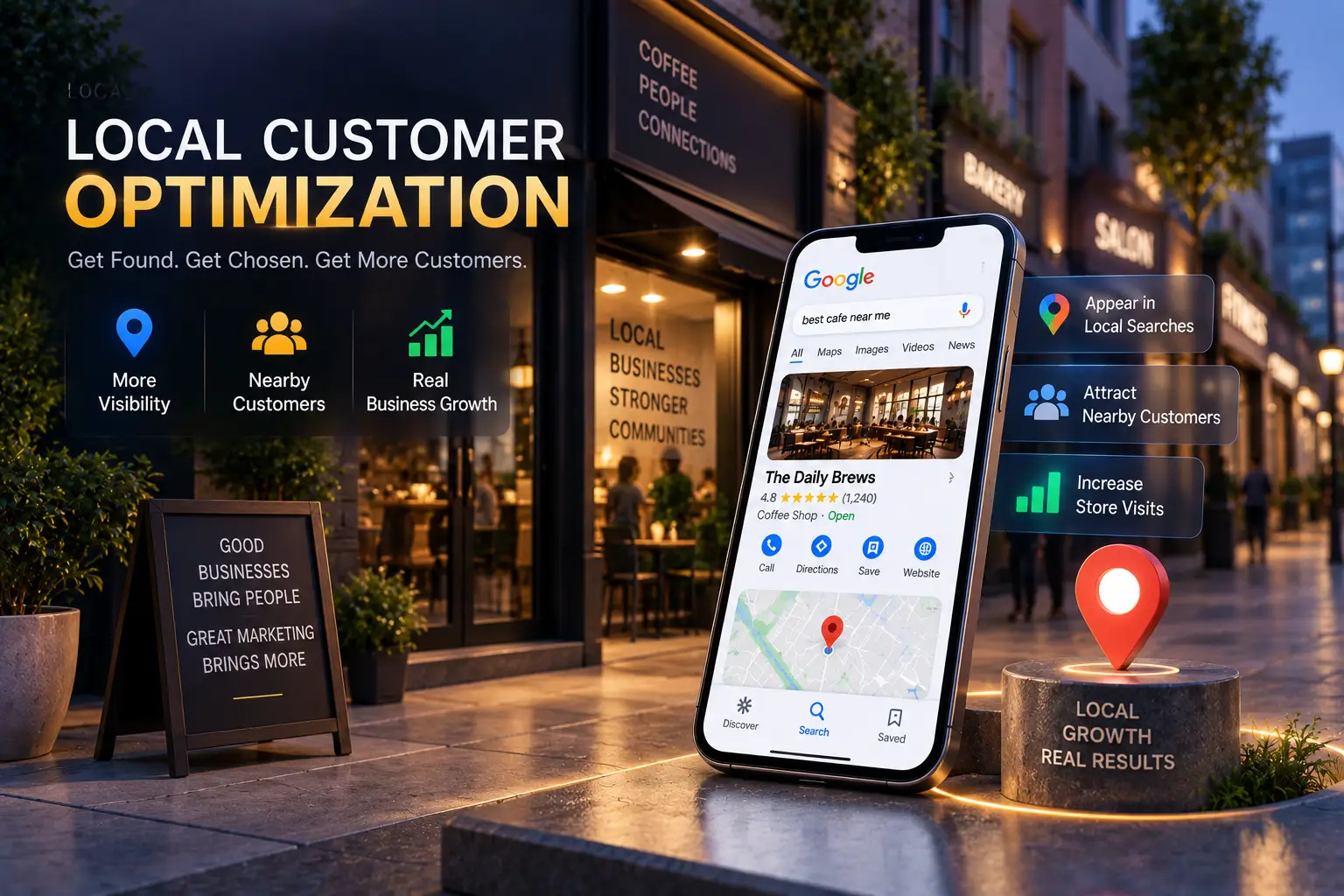
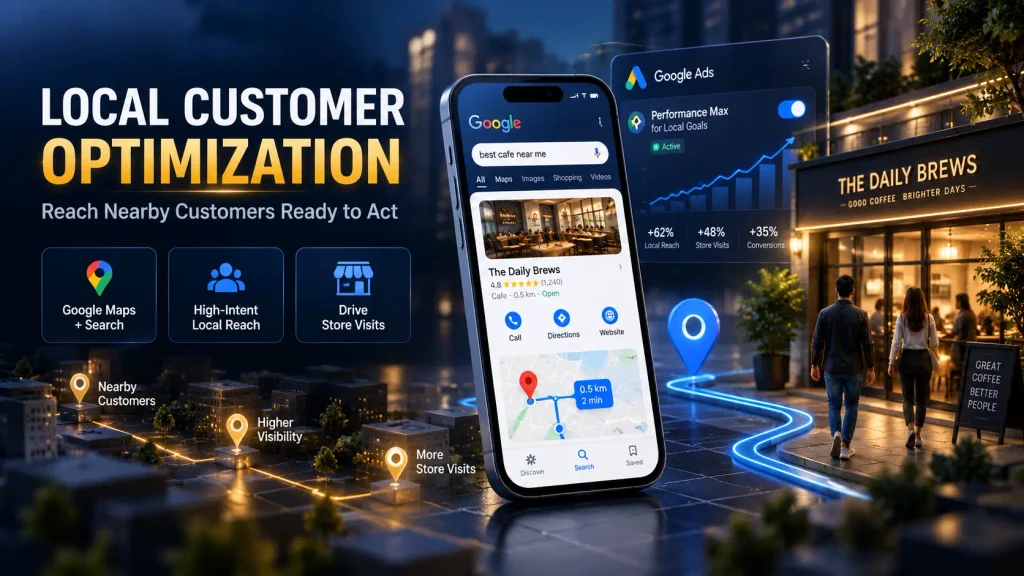
Local Customer Optimization is a new setting inside Performance Max campaigns for store goals, and it is designed to solve a problem that has frustrated local businesses for years, reaching people who are physically nearby and ready to act right now. Google rolled out Local Customer Optimization globally in 2026, timed specifically ahead of the Q4 holiday shopping season, alongside a related update called Store Sales in Data Manager. This guide explains exactly what Local Customer Optimization does, who is eligible to use it, and how to turn it on, based directly on Google’s own documentation.
THE BASICS
What Is Local Customer Optimization
According to Google’s own support documentation Local Customer Optimization allows you to prioritize reaching potential customers who are close to or interested in your business area and ready to take action immediately, such as visiting or making contact.
Local Customer Optimization specifically targets people at the most critical moment, while they are actively navigating, trip planning, or searching for locations on Google Maps, Waze, or Google Search for a service in a specific area. This is a meaningful gap Google is filling, since Performance Max previously had no dedicated way to prioritize this exact kind of nearby, high intent behavior.
KEY BENEFITS
Key Benefits of Local Customer Optimization
Google outlines two specific benefits of Local Customer Optimization for businesses with physical locations.
Capturing ready to act customers means reaching users who intend to take action immediately, as they plan routes, search for services, or travel near your business location with clear, immediate intent.
Targeted local reach means directing campaign budget specifically toward locally tailored ads across Google Maps, Waze, and local formats within Google Search, rather than spreading spend broadly across less relevant placements.
Local Customer Optimization is not a general Performance Max upgrade, it is a specialist setting built specifically for offline, store visit goals. Turning it on for the wrong campaign type simply will not work.
ELIGIBILITY CHECK
Eligibility Requirements for Local Customer Optimization
Local Customer Optimization is only available under specific conditions. Your campaign must be a Performance Max campaign built specifically for store goals, using offline conversion goals such as store visits, store sales, contacts, or directions.
Local Customer Optimization is not compatible with online campaign goals, and it does not work alongside Performance Max campaigns using products from a Merchant Center account. If your account is linked to Merchant Center, you will need to either deselect that product feed or create a separate, dedicated campaign for Local Customer Optimization to work.
Here is exactly what makes Local Customer Optimization work or fail at a glance.
| Compatible | Not Compatible |
|---|---|
| Performance Max for store goals | Performance Max for online sales goals |
| Store visits as a conversion goal | Merchant Center linked product feeds |
| Store sales as a conversion goal | Standard Shopping or ecommerce campaigns |
| Contacts, Google hosted | Campaigns mixing online and offline goals |
| Directions, Google hosted |
HOW TO ENABLE IT
Step by Step: How to Enable Local Customer Optimization
In Google Ads, go to Campaigns and select New Campaign, then choose Local Store Visits and Promotions as your objective, followed by Performance Max as the campaign type.
Set your conversion goals to store visits, store sales, contacts, or directions, since Local Customer Optimization only works with these offline goal types.
You will see a dedicated Local Customer Optimization panel during setup. Turn on the toggle and select the business locations you want to target.
For an existing eligible campaign, go to Settings, then Budget and Bidding Optimization, where you will find the Local Customer Optimization panel. Turn it on and select Save to activate it.
IMPORTANT LIMITATION
The Merchant Center Limitation Businesses Miss
This is the detail that trips up the most advertisers. If your Performance Max campaign is linked to a Merchant Center account and advertising products from that feed, Local Customer Optimization will not work, even if you turn the toggle on.
Google specifically recommends deselecting Advertiser Products From a Merchant Center Account during setup, or building a completely separate campaign dedicated purely to store goals, to make Local Customer Optimization function correctly.
Check your account structure before enabling Local Customer Optimization. If you are unsure whether a campaign is linked to Merchant Center, review the campaign settings first rather than assuming the toggle alone will work.
IS THIS FOR YOU
Should Your Business Use Local Customer Optimization
Local Customer Optimization makes the most sense for businesses with one or more physical locations that depend on foot traffic, phone calls, or in person visits, restaurants, clinics, showrooms, service centers, and retail stores among them.
Multi location businesses see particularly strong value from Local Customer Optimization, since it lets them consolidate local targeting into a single Performance Max campaign rather than managing multiple separate setups for each location.
Expert Insight
Most local businesses are still running Performance Max the same way an ecommerce brand would, chasing online conversions. Local Customer Optimization only works once you commit fully to offline goals, and that mindset shift is where most advertisers get stuck first.
How Sanrovax Helps
Sanrovax helps local and multi location businesses set up Performance Max campaigns correctly for store goals, including configuring Local Customer Optimization to actually work within their existing account structure.
Talk to SanrovaxFrequently Asked Questions
1. Local Customer Optimization kya hota hai simple bhasha mein?
It is a Performance Max setting that prioritizes showing your ads to people nearby who are ready to visit your store, request directions, or make contact right away.
2. Is Local Customer Optimization available for every Performance Max campaign?
No, it only works for Performance Max campaigns built specifically for store goals using offline conversion goals like store visits, store sales, contacts, or directions.
3. Kya Merchant Center account wale campaigns mein ye feature kaam karega?
No, Local Customer Optimization is not compatible with Performance Max campaigns advertising products from a Merchant Center account, even if the toggle is turned on.
4. How do I turn on Local Customer Optimization for an existing campaign?
Go to your campaign settings, open Budget and Bidding Optimization, and turn on the Local Customer Optimization panel before selecting Save.
5. Kaunse business type ke liye ye feature sabse zyada faydemand hai?
Businesses with physical locations that depend on foot traffic or in person visits, such as restaurants, clinics, showrooms, and retail stores, benefit the most.
6. Can I use Local Customer Optimization alongside online sales goals?
No, Local Customer Optimization is not compatible with online campaign goals, since it is specifically designed for offline, store focused objectives.
7. Ye feature kaise reach improve karta hai?
It prioritizes ad delivery to people actively navigating, trip planning, or searching for locations on Google Maps, Waze, and local Search formats near your business.
8. Is Local Customer Optimization useful for multi location businesses?
Yes, it allows multi location businesses to consolidate local targeting into a single Performance Max campaign instead of managing separate campaigns for each location.
9. Kya ye feature turn off bhi kiya ja sakta hai baad mein?
Yes, Local Customer Optimization can be disabled at any time, which returns the campaign to standard Performance Max store goals behavior.
10. Why did Google launch Local Customer Optimization now?
Google rolled out Local Customer Optimization ahead of the Q4 holiday shopping season, alongside a related feature called Store Sales in Data Manager, to help businesses connect online activity with in store results.
Conclusion
Local Customer Optimization gives local and multi location businesses a genuinely useful way to prioritize nearby, high intent customers inside Performance Max, but only once the eligibility requirements are met correctly. Getting the campaign structure right, particularly around Merchant Center compatibility, determines whether this feature actually works or quietly fails.
If you want help setting up Local Customer Optimization correctly for your business, reach out directly.
Website: https://sanrovax.com Email: sandip@sanrovax.com