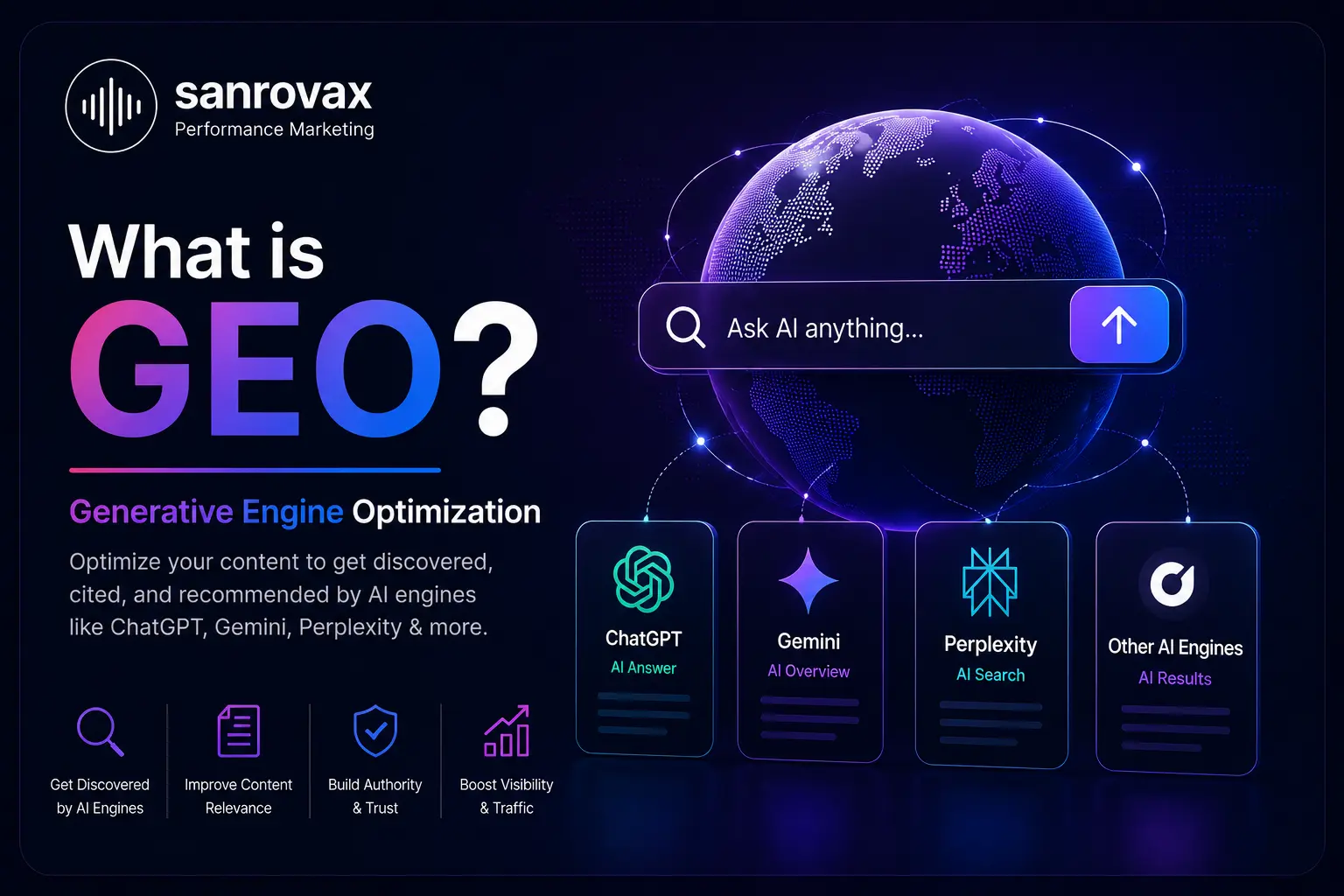
What is GEO, and why do marketers keep bringing it up alongside AEO and SEO this year. Generative Engine Optimization, or GEO, is the practice of shaping your content, brand presence, and digital assets so generative AI systems like ChatGPT, Gemini, Perplexity, and Claude are more likely to cite, reference, or directly use your information when generating an answer. Unlike traditional ranking, GEO focuses on something more specific, whether your brand becomes part of the actual answer a generative engine produces, not just a link sitting quietly on a results page.
THE BASICS
What Is GEO in Simple Terms
GEO stands for Generative Engine Optimization. The concept was first formally introduced in a 2024 research paper from Princeton University and IIT Delhi, which studied how generative AI systems select, synthesize, and cite information from across the web.
Where traditional search engines return a ranked list of links, generative engines behave completely differently. They ingest content from multiple sources at once, then generate a single synthesized response, sometimes citing sources directly and sometimes blending information without any visible citation at all. GEO is the practice of making sure your content is the kind these systems genuinely choose to pull from in the first place.
GEO VS AEO VS SEO
GEO vs AEO vs SEO: What Is Actually Different
These three terms get used interchangeably online, but each one solves a slightly different problem. Here is how they actually compare, side by side.
| Factor | SEO | AEO | GEO |
|---|---|---|---|
| Primary Goal | Rank high on the results page | Become the direct answer to a question | Become a cited source across AI generated responses |
| Scope | Search results pages | Featured snippets and AI Overviews | ChatGPT, Gemini, Perplexity, Claude, and beyond |
| Core Focus | Keywords and backlinks | Direct, question based answers | Credibility, citations, and brand presence |
| Success Metric | Clicks and rankings | Featured answer placements | Share of model, citations, and brand mentions |
None of these three disciplines replace each other. A strong GEO strategy is usually built directly on top of solid SEO and AEO foundations, not instead of them.
WHY IT MATTERS
Why GEO Matters Right Now
The scale of this shift is bigger than most businesses realize. ChatGPT alone now reaches more than eight hundred million weekly users, while Google’s Gemini app has surpassed seven hundred and fifty million monthly users. AI Overviews already appear in at least sixteen percent of all Google searches, and that share climbs significantly higher for comparison and high intent queries, the exact kind of searches that lead to real business decisions.
According to Search Engine Land’s coverage of this shift, research backed GEO strategies can boost AI visibility by up to forty percent. For businesses that depend on being discovered online, ignoring GEO at this point means quietly disappearing from an entire, fast growing discovery channel.
Well known brands often start with more built in authority, but they do not automatically win at GEO. Smaller, focused brands can compete effectively when they own a clearly defined topic and stay consistent across platforms.
HOW TO DO IT
How to Actually Do GEO
Research shows quotation addition is the single most effective tactic for improving GEO performance. Include clear, quotable statements that generative engines can lift directly into a synthesized answer.
Specific numbers and data points significantly increase the likelihood that your content gets selected as supporting evidence inside an AI generated response.
Content that reads clearly and flows naturally performs better than content that is technically correct but awkward to parse. Generative engines favor passages that are easy to extract cleanly.
Content that references credible external sources signals trustworthiness, which increases the likelihood that generative engines treat your content as reliable enough to cite in return.
Correct, specific terminology performs better than vague, generalized language, since generative engines rely heavily on precise language to match content to the right query.
AVOID THESE
What Does NOT Work for GEO
Not every SEO tactic transfers over to GEO, and some genuinely work against you.
| Keyword stuffing | Natural, fluent writing performs significantly better, research shows keyword stuffing has a negative or negligible effect on GEO |
| Vague, generalized claims | Specific statistics and precise, checkable data points |
| Ignoring where your brand gets mentioned elsewhere | Actively tracking and building unlinked brand mentions across the web |
| Optimizing for a single AI platform only | Structuring content that performs well across ChatGPT, Gemini, Perplexity, and Claude together |
| One time content publication | Continuous testing and iteration, since GEO performance shifts as models update |
Track your brand’s Share of Model, how often you get mentioned across major AI platforms compared to competitors, the same way you would track share of voice in traditional marketing.
Expert Insight
GEO is the first optimization discipline where stuffing keywords actively hurts you instead of helping. The businesses that win here are the ones writing like they are being quoted, not writing like they are simply being searched.
How Sanrovax Helps
Sanrovax helps businesses across India, Australia, and the UK build content and brand strategies that perform across traditional search, answer engines, and generative AI platforms together, so visibility does not depend on any single channel alone.
Talk to SanrovaxFrequently Asked Questions
What is GEO in simple terms?
GEO, or Generative Engine Optimization, is the practice of shaping content and brand presence so generative AI systems like ChatGPT and Gemini are more likely to cite or reference it when generating an answer.
Is GEO the same as AEO?
No, though they are closely related. AEO focuses on becoming the direct answer to a specific question, while GEO covers the broader goal of being cited and referenced consistently across generative AI platforms.
Does GEO replace traditional SEO?
No, GEO builds directly on top of SEO rather than replacing it. Strong crawlability, quality backlinks, and solid content remain the foundation most effective GEO strategies are built on.
Does keyword stuffing help with GEO?
No, research has found keyword stuffing has a negative or negligible impact on GEO performance, while natural, fluent writing performs significantly better across generative platforms.
Which platforms does GEO apply to?
GEO applies broadly across ChatGPT, Google Gemini, Perplexity, Claude, and other generative AI systems that synthesize answers from multiple sources at once.
What is Share of Model in GEO?
Share of Model refers to how often your brand gets mentioned or cited across major AI platforms compared to your competitors, similar to share of voice in traditional marketing.
Can small businesses compete effectively with larger brands in GEO?
Yes, smaller brands that clearly own a specific topic and stay consistent across platforms can compete effectively, since generative engines do not automatically favor brand size alone.
What GEO tactics actually work based on research?
Adding direct quotations, backing claims with statistics, optimizing for fluency, citing credible sources, and using precise technical terminology are the tactics research has shown to work best.
How is GEO performance measured?
GEO performance is typically measured through citation frequency, brand mentions across AI platforms, referral traffic from AI tools, and assisted conversions from users who discover a brand through AI.
Who first introduced the concept of GEO?
The concept was formally introduced in a 2024 research paper from Princeton University and IIT Delhi, which studied how generative AI systems select and synthesize information from the web.
Conclusion
What is GEO, at its core, comes down to becoming part of the answer instead of just another link on a results page. Businesses that add clear quotations, back claims with real statistics, and stay consistent across multiple AI platforms are the ones building genuine visibility as more of the internet’s discovery shifts toward generative engines.
If you want help building a GEO ready content and brand strategy, reach out directly.
Website: https://sanrovax.com Email: sandip@sanrovax.com
Key Statistics
Important Articles
Prepared by Sanrovax, Performance Marketing and Growth Systems
1 thought on “What Is GEO? Don’t Ignore The Overlooked Strategy Boosting AI Visibility by 40%”